Asparagus Planting Guide: Crowns to Harvest
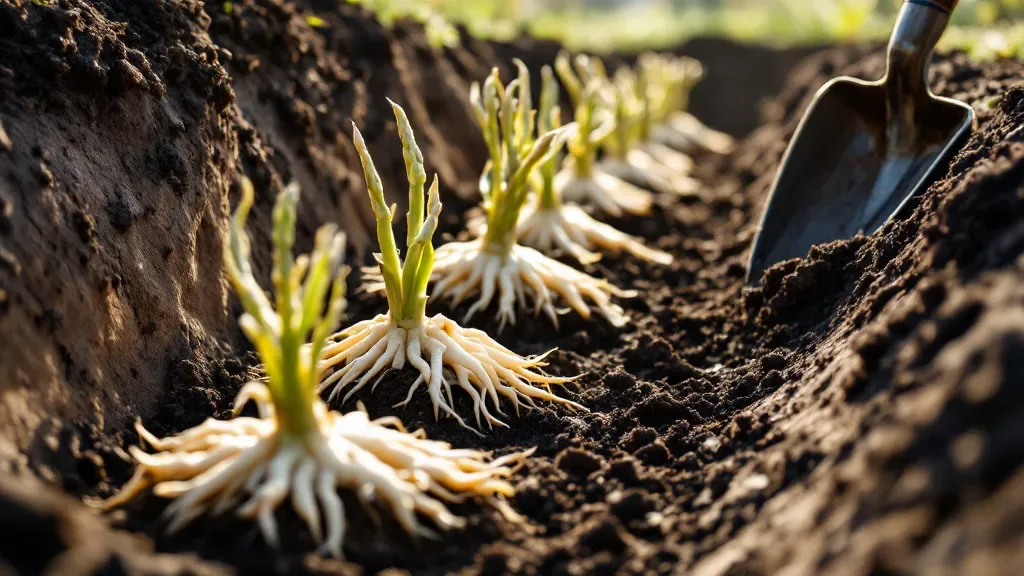
You are about to put a bed in the ground that will outlast most of your other vegetables. An asparagus planting guide comes down to three numbers: set one-year crowns 12 to 18 inches apart in early spring, cover them with 2 to 3 inches of soil, and leave the spears alone for the first season.
Published
Asparagus planting guide at a glance
Asparagus is a perennial that lives 12 to 15 years or longer, according to a Virginia Cooperative Extension publication on asparagus. You plant it once and manage it for years. The table shows the five steps and the number that matters in each.
| Step | What you do | The number to use |
|---|---|---|
| 1 | Choose a sunny, well-drained spot | 12 to 15 years in one place |
| 2 | Set 1-year crowns in a trench | 12 to 18 inches apart, 2 to 3 inches of soil on top |
| 3 | Fill the trench as the shoots grow | About 2 inches of soil every two weeks |
| 4 | Wait, harvest lightly, then harvest fully | No spears in season 1 |
| 5 | Let the ferns grow, then cut them down | 2-inch stubs after frost |
Plan a perennial bed the way you would plan a fence: once, carefully, and in the right place.
Step 1: Pick a spot that can stay for a decade
Put the bed in full sun on well-drained soil. Virginia Cooperative Extension lists a deep sandy loam and a soil pH of 6.0 to 6.7 as the preference. It also warns that the tall ferns may shade other plants, so decide where that shade will fall before you dig.
Add phosphorus and potassium during bed prep if your soil test calls for them. Virginia Tech says phosphorus moves down slowly, so it belongs in the soil before you plant.
You will not rotate this bed. Mark it as permanent on your garden map, and draw the annual beds around it. A printable kit with a whole-plot graph and a rotation planner gives you somewhere to draw it once.
Step 2: Set the crowns in a trench
Start with 1-year crowns from a nursery you trust. Virginia Cooperative Extension says crowns are usually shipped and set out in March or April, and Utah State University Extension says to plant them in April. Starting from seed adds a year before the first harvest.
Dig the trench 12 to 18 inches wide, with 4 to 5 feet between trenches. Spread about 2 inches of soil mixed with compost in the bottom. Set the crowns on a small mound, spread the roots over it, and cover them with 2 to 3 inches of soil.
Spacing varies between the two sources. Virginia Tech says to set plants 15 to 18 inches apart. A Utah State University Extension guide to growing asparagus says 12 inches apart in the row, with rows 4 feet apart. Pick a spacing between 12 and 18 inches and stay with it along the whole row.
Step 3: Fill the trench as the shoots grow
The crowns start 2 to 3 inches down, and the trench stays open. As the plants grow, pull soil over them, about 2 inches every two weeks, until the trench is level. Water if rain is short.
Weed the bed each spring before the first shoots come up. The Virginia guide says to pull weeds rather than hoe them while the bed is producing, so you do not snap off spears.
Step 4: Wait, then harvest in stages
Do not cut spears in the first season. The Virginia publication says research plots harvested one year after planting had a cumulative yield 23% lower after five years than plots first harvested two years after planting. The fleshy roots need time to store food.
The two sources give different schedules, so the table puts them side by side.
| Season | Virginia Tech (426-401) | Utah State |
|---|---|---|
| 1 (crowns set) | No harvest | No harvest |
| 2 | Light harvest, 3 to 4 weeks | No harvest |
| 3 | Third-year spears | Up to 4 weeks |
| 4 | 8 to 10 weeks | 6 weeks |
| 5 and later | 8 to 10 weeks each year | Up to 8 weeks |
If you want the cautious count, follow Utah State and skip the harvest through season 2. Stop each season when most spears are thinner than a pencil, which Utah State puts in early to mid-June in most areas.
Step 5: Let the ferns grow, then cut them down
After harvest ends, let the spears grow into ferns. They feed the crowns for next spring. Cut the foliage to 2-inch stubs after frost, when it yellows and before the red berries fall off, which Virginia Cooperative Extension says reduces overcrowding from self-sown seedlings. Then add 4 to 6 inches of compost, manure or leaves.
So yes, you cut the ferns down every fall. The one summer exception is a two-bed method Virginia Cooperative Extension describes for gardeners with space: cut the ferns on half the planting in late July to get new spears for a fall harvest.
How many crowns one person needs
Virginia Cooperative Extension suggests raising 6 pounds of asparagus per person. It gives a yield of 3 to 4 pounds per 10-foot row each year. Utah State says a mature plant can give about three-quarters of a pound.
Three figures and some division give a range.
| Source | The sum | Result |
|---|---|---|
| Virginia Tech, 18 inch spacing | 6 lb ÷ 4 lb × 10 ft = 15 ft; 6 lb ÷ 3 lb × 10 ft = 20 ft | 10 to 13 crowns |
| Utah State | 6 lb ÷ ¾ lb per plant | 8 crowns |
Plant 8 to 13 crowns for each person who eats asparagus, in a row 12 to 20 feet long. Count the crowns against your trench length before you order.
When this guide is plenty
If your county extension office publishes its own asparagus schedule, use its dates and its spacing. Local advice beats a general one, and the two sources here already disagree by a season. A free extension sheet also covers the crown planting itself, so for the trench, the depth and the harvest weeks the steps above are all you need.
The paper is for the part no sheet draws, which is where the bed sits for the next decade. The Winter Plan counts from your own last-frost date and holds a 108-station freeze table (1991-2020 normals), so compare your nearest station with the March or April advice above. It carries no crown schedule, so extension dates still set the day.
The download is a zip with US Letter and A4 PDFs, which you print at 100 % on a home printer to keep the whole-plot graph at 1/4 inch to the foot. You draw the asparagus row there in winter, write the crown-planting day in the season calendar, log the fern cutting on the fall countdown, and keep the planting year on the notes for next winter page.
FAQ
What month do you plant asparagus?
In early spring. Virginia Cooperative Extension says crowns are usually shipped and set out in March or April, and Utah State Extension says to plant them in April.
Do you cut asparagus down every year?
Yes, once the ferns have turned yellow. Virginia Cooperative Extension says to cut the foliage down to 2-inch stubs after frost, before the red berries fall off, and Utah State Extension says to mow the dead ferns down in the fall.
Why is asparagus difficult to grow?
It is slow more than hard. Virginia Cooperative Extension says the plants should not be harvested the first season, and it lists weak, spindly plants from harvesting too early or too heavily, and crown rot in heavy, poorly prepared soil, as the main cultural problems.
Conclusion
Prepare the bed early and dig the trench in early spring, set the crowns 12 to 18 inches apart, and write the planting year on your garden plan. Skip the harvest in season one, cut lightly in season two, and let the ferns grow every summer after that. Plant 8 to 13 crowns for each person you want to feed, and cut the ferns to 2-inch stubs after the first frost has yellowed them.
Sources
- Virginia Cooperative Extension, Asparagus, Publication 426-401 (2026), last checked October 5, 2026
- Utah State University Extension, How to Grow Asparagus in Your Garden (2020), last checked October 5, 2026