A companion planting guide built from numbered sources
Four published lists were merged row by row and checked against 32 numbered sources, mostly US extension and university publications. Where lists disagree, the page shows both.
Spring · Pair the crops
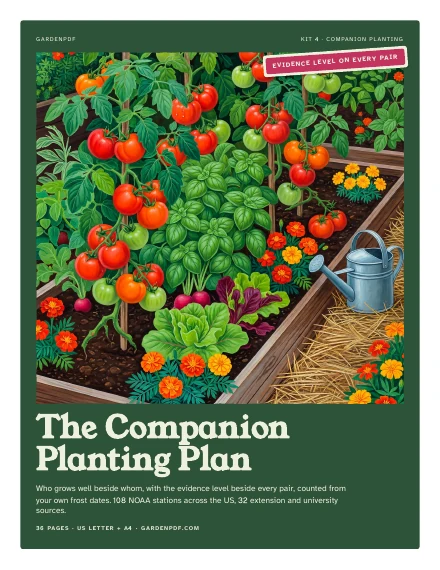
Thirty-six printable pages that show which vegetables, herbs and flowers sit well together, say how good the evidence is for each pair, and put the pairs on a calendar and into a bed drawn to scale.
Want all four kits? Pay $14.00, the price of two, and get every kit.
What exactly you get
Four published lists were merged row by row and checked against 32 numbered sources, mostly US extension and university publications. Where lists disagree, the page shows both.
Who sits well beside whom, grouped by how the herbs like to grow, with the weeks from last frost for basil, dill and parsley.
How you use it
Look up your station on pages 4 to 6 and copy six freeze dates to page 3.
Find a crop on the vegetable chart, then follow the key numbers to the source.
Put the pair on your calendar, then draw the bed at 1 inch = 1 foot.
The file
One zip with two PDFs: US Letter and A4, 36 pages each.
At home, at 100 %, so grids keep their true measurements. Fill in by hand.
A download link by email right after payment. No account.
Print as many copies as you need for your own garden and household, in any year. No reselling or sharing.
All four kits, together worth $28.00. One payment, no account, US Letter and A4.
FAQ
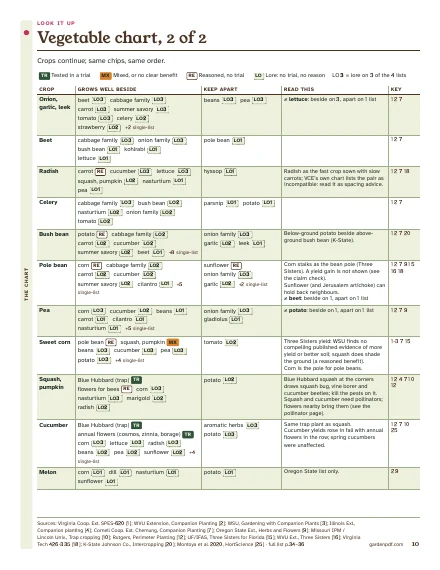
Pages 9 and 10 are the vegetable chart: 19 crops, each with what grows beside it, what to keep apart and the numbered sources behind it.
Tomato is a good crop to start with. The chart rates basil beside tomato as tested, lettuce as reasoned and marigold as mixed, and tells you what to keep away from it: fennel, potato, the cabbage family and black walnut.
The “keep apart” page lists ten reasons plants should not share a bed, and where reputable lists disagree it says so rather than averaging them.
Page 11 covers 11 herbs: who sits well with whom, the culture groups, and the weeks from last frost for basil, dill and parsley.
Pick pairs on the chart, check the timing so fast crops do not shade slow ones, then draw the bed. Bed plans for a tomato, pepper and basil bed and a cabbage-family bed are printed at 1 inch = 1 foot.
It depends on the crop. The kit lists nine jobs a neighbour does, from shading and trapping pests to attracting pollinators, so you can choose a partner for the job you need.
Related guides
Sourced guides that lead to this kit, most useful first.
All guides (56)