Backyard Garden Planner: A Worked 10x10 Plan
You have a patch of lawn and one season to turn it into vegetables. A backyard garden planner is four decisions on one page: where the sun falls, how big the plot is, which crops go in it, and what gets planted first.
Published
Check the sun before you pick the spot
Sun decides the whole plan, so check it first.
A University of Wisconsin-Madison Extension article says most vegetables need at least six hours of direct sun a day. It tells you to watch a possible spot through the season, because trees or buildings can shade it from late morning through the afternoon. It also says to avoid low spots where frost settles and steep slopes, and to keep clear of black walnut roots and underground utility lines. Add a hose within reach.
An Oregon State University Extension handout is stricter about fruit. It says eight hours of sun is crucial for tomatoes, cucumbers, squash, eggplant, peppers and melons. Lettuce and spinach tolerate partial shade.
Walk the yard at 9 a.m., noon and 3 p.m. and mark where the shade falls. Give the sunniest ground to the fruiting crops and the shadier edge to the greens.
Size the plot: start with 100 square feet
The Oregon State handout says beginners may try a 10 by 10 foot plot, and that 30 by 30 feet yields enough fresh produce for a family of four. It puts planting and cultivation of a 10 by 10 plot at about 40 minutes a week, plus 30 minutes for each watering. A Kansas State University guide says even a 100 square foot garden can produce a good portion of the vegetables for a family of four.
Illinois is more modest. Its Extension column on a first-time garden says a 10 by 10 foot garden will supply the fresh vegetables for a family of four for the summer. The sources differ, so size the plot to the hours you have, not to the head count. Neither gives a plant count per person.
The sums are easy. A 10 by 10 plot is 100 square feet. A 30 by 30 plot is 900 square feet, which is nine times as much ground and nine times the weeding.
A small garden you finish beats a big garden you give up on in July.
A bigger plot is fine if you have the hours. Start at 100 square feet and add a bed next year once you know what you actually ate.
Split the plot into two beds and a path
Cut the plot into beds instead of rows. A Colorado State University Extension fact sheet says to make beds three to four feet wide and walkways 18 to 24 inches wide, so you can reach in from the path and never compact the soil. A four foot bed is one you can reach across from the side.
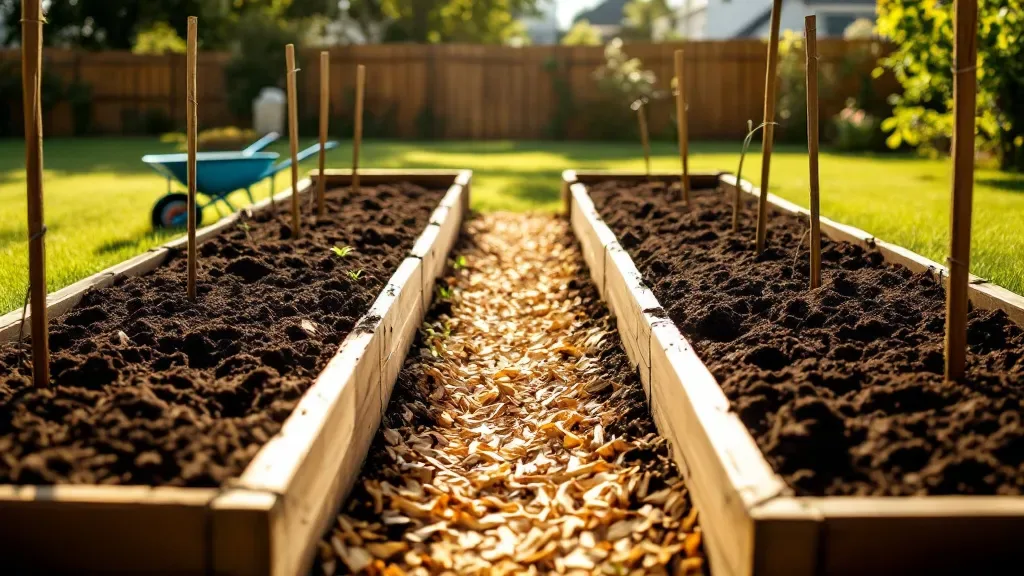
Here is the split for a 10 by 10 plot. Two beds that are 4 feet wide add up to 8 feet, and a 2 foot path makes 10. Each bed is 4 by 10 feet, or 40 square feet. Two beds give you 80 square feet of growing space, and the path takes the other 20.
Pick a crop list that fits two beds
Start with what you eat. The handout advises beginning with what you like, high-cost crops such as herbs, and short-season crops. A University of Illinois Extension column says a 10 by 10 plot may hold one tomato, one or two peppers, snap beans, radishes and a bush-type cucumber. It adds that you should plan more than one planting of snap beans and be ready to plant fall radishes.
The table turns that into a plan. Spacings come from the Colorado State sheet, and days to harvest come from the Kansas State guide.
| Bed | Crop | Spacing | Days to harvest | Your count |
|---|---|---|---|---|
| A | Tomatoes, trellised | 24 inches apart in one row down the middle | 52 to 120 from transplant | 3 plants take 6 feet |
| A | Peppers | 15 by 15 inches, three across the bed | 50 to 110 from transplant | 3 plants take 15 inches |
| A | Cucumbers, trellised | 9 inches along the trellis | 45 to 65 | 3 plants take the last 2.75 feet |
| B | Radishes | 2 to 3 inches each way | 25 to 40 | 64 in a 4 by 1 foot block at 3 inches |
| B | Leaf lettuce | 7 to 9 inches each way | 45 to 65 | 30 in a 4 by 5 foot block at 9 inches |
| B | Bush beans | double row, 12 inches between rows, 4 inches apart | 50 to 60 | 24 in the last 4 feet |
Bed A adds up to 10 feet: 6 for tomatoes, 1.25 for peppers and 2.75 for cucumbers. Bed B adds up to 10 as well: 1 foot of radishes, 5 of lettuce and 4 of beans.
Radishes, lettuce and the rest come out early. Colorado State says to replant a row of radishes, beets, lettuce or spinach right after you pull it, which keeps the harvest going. Use the freed bed space for a second round of quick crops.
Put the season in order
The order follows frost. The Kansas State guide rates radishes as hardy, lettuce as half-hardy, tomatoes, peppers and bush beans as tender, and cucumbers as very tender. Hardy crops go in first. Tender ones wait until your last frost has passed.
Tomatoes and peppers also need a head start. The guide says to allow 4 to 8 weeks indoors for transplants. The handout adds that tomatoes mature in 75 to 90 days, so a gardener is in a race to harvest before the cold nights.
Your own last-frost date turns that order into calendar dates. The Garden Year bundle counts every date from the last-frost date you enter, so you do not need a zone chart.
Mistakes that wreck a first backyard plan
Most first plans fail in five ways.
- Too big. Both the Oregon and Wisconsin sources say to start small.
- Too little sun for fruit. Kansas State lists excessive shade as the cause of tall, spindly, unproductive plants.
- A bad spot. Oregon State says low areas have drainage problems and cold air settles in them.
- Crowding. Wisconsin says crowded plants are less productive and more prone to disease.
- Tender crops set out early. Check the frost rating above before you plant.
Two fixes work mid-season. Colorado State says to replant a row of radishes, beets, lettuce or spinach right after you pull it, and Illinois says to plan more than one planting of snap beans. Wisconsin says to work a two to three inch layer of compost into the soil, so leave room near the beds for a pile or bin. None of the sources says where that pile should go.
A small backyard garden planner can be graph paper
A 10 by 10 plot will not feed your family for the year. If you want that, plan on something closer to the 30 by 30 foot plot Oregon State describes, and expect more hours.
A printed plan also suits people who like paper. If you want to drag shapes around on a screen or share one live plan, an app or a shared spreadsheet fits better. And if your state extension office already publishes a planting calendar for your county, that plus graph paper may be all you need, since free sheets are good on spacing and days to harvest.
The Winter Plan page in The Garden Year is a yard and sun map on a dot grid, with a sun check, plus bed plans at true scale where 1 inch stands for 1 foot. After you pay the download link is emailed to you. The zip holds US Letter and A4 PDFs to print at 100 % on a home printer. Dates count from your own last-frost date in any US zone, with a 108-station NOAA freeze table in every kit. You draw the sun map in winter, then use the Season Record planting log when you sow and its harvest tally each week. Print the sun map first and see if paper works for you.
FAQ
What is a simple way to layout a garden?
Mark a 10 by 10 foot square, then divide it into two beds 4 feet wide and 10 feet long with a 2 foot path between them. Four feet is a width you can reach across from either side, so you never step on the soil. Put the crops that need the most sun in the sunniest bed.
What are some common mistakes to avoid in garden plans?
Planning a plot bigger than you can tend, putting fruiting crops in less than a full day of sun, planting in a low spot or on a slope, crowding plants, and setting tender crops out before your last frost. Start with 100 square feet and a short crop list.
Conclusion
Stake a 10 by 10 foot square this weekend and watch where the shade moves before you buy seed. Plan two 4 by 10 foot beds and a 2 foot path, plant the hardy crops first and the tender ones after your last frost. Write down what you sowed and when, so next year's plan starts from facts.
Sources
- Oregon State University Extension Service, Starting Your Vegetable Garden (undated), last checked October 5, 2026
- University of Wisconsin-Madison Extension, Beginning Vegetable Garden Basics: Site Selection and Soil Preparation (2021), last checked October 5, 2026
- Colorado State University Extension, Block Style Layout in Raised Bed Vegetable Gardens, GardenNotes 713 (2023), last checked October 5, 2026
- Kansas State University Research and Extension, Vegetable Garden Planting Guide, MF315 (2023), last checked October 5, 2026
- University of Illinois Extension, Planting a First-Time Vegetable Garden (2020), last checked October 5, 2026