Crop Rotation Garden Planner: 4 Beds, 4 Years
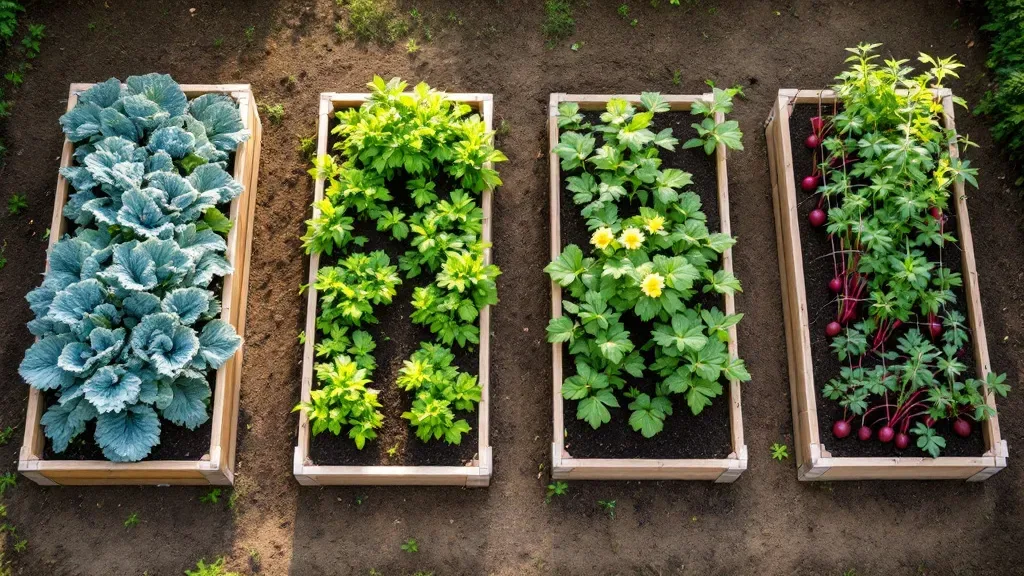
You grow tomatoes, kale and beans, and you do not want any of them back in the same bed next year. A crop rotation garden planner is a grid of four beds and four years that puts each plant family in a different bed every season, so no family comes back to a bed for four years.
Published
Step 1: Sort your crops by plant family
Plant family is the only fact you need to start. Washington State University says vegetables in the same family are often hit by the same insect pests and diseases, and they take up similar nutrients. Plant the same family in the same spot year after year and pests get a reliable food source.
A Washington State University Extension fact sheet from Snohomish County gives a table of common vegetables and their families. The rows below are taken from it.
| Plant family | Vegetables in the table |
|---|---|
| Nightshade | Tomato, pepper, eggplant, potato, tomatillo |
| Broccoli (cabbage) | Broccoli, cabbage, kale, collards, radish, turnip, arugula |
| Pea and bean | Peas, bush beans, pole beans, lima beans |
| Goosefoot | Beets, spinach, Swiss chard |
| Gourd | Cucumber, summer squash, winter squash, pumpkin, watermelon |
| Carrot | Carrot, celery, parsley, dill, parsnip |
| Onion | Onion, garlic, leek, shallot |
| Sunflower | Lettuce, endive |
| Grass | Corn |
Write your own crop list next to the family names. Radish surprises people, because it belongs with the cabbage family. Peppers and potatoes surprise people the other way, because they share a bed group with tomatoes.
Crops in the same family share pests, so a new bed beats a new variety.
Step 2: Give each family group its own bed
Four beds fit four family groups. Washington State University's four-bed, four-year diagram uses potatoes (nightshade), kale (broccoli family), peas (pea and bean family) and beets (goosefoot family).
Clemson Cooperative Extension builds its sample the same way with four beds and four crops: tomatoes, sweet corn, okra and beans. A 2021 Clemson fact sheet also says rotating tomatoes, peppers and eggplant with each other is not recommended, because all three are nightshades.
Squash, onions and carrots sit outside those four groups. Give each one a bed of its own if you have the room, or add a fifth bed. Write the family beside every crop so you always know which group a bed belongs to.
Step 3: Fill the crop rotation garden planner grid
Shift every group one bed to the right each spring. The group in bed 4 wraps around to bed 1. Clemson's table moves each crop one bed per year too.
The grid has 16 cells, which is 4 beds times 4 years. Each family appears 4 times, and each bed holds every family once. Nightshade sits in bed 1 in year 1 and does not return until year 5. That is a four-year gap, the top of Washington State University's advice to wait three to four years. Clemson calls three years the minimum and says four or five is even better.
| Step | What you do | Number to keep |
|---|---|---|
| 1 | Sort crops by plant family | 9 families in the table above |
| 2 | Give each family group a bed | 4 beds |
| 3 | Shift every group one bed right each spring | 16 cells, 4 per family |
| 4 | Write the grid and the bed map down | 1 sheet per year |
Step 4: Write each year's bed map down
The grid only works if you can see where things grew. The Snohomish County fact sheet says to keep a garden log or map as a reminder of where vegetables are planted each year. A pencil sketch of four boxes with the crops named inside is enough.
Print a fresh copy each spring. Cross out last year's family, write the new one, and note any crop that did badly. If a bed picked up a disease, that note tells you to keep its family away longer than four years.
Cross out last year's family on a ruled sheet and the new grid is done.
What to plant after tomatoes
Tomatoes belong to the nightshade family, so the next crop in that bed must come from another family. Peppers, eggplant and potatoes are the crops to avoid after tomatoes, and the Washington State fact sheet says why: all of them are nightshades. Clemson's sample table follows tomatoes with sweet corn.
In the grid above, the bed that held nightshades gets the goosefoot group the next year. Beets, spinach and Swiss chard all come from that family. After that, the pea and bean group takes the bed, and then the broccoli family.
If the Same Family Is Already in Last Year's Bed
You planted tomatoes where tomatoes grew last year, and you cannot move them. Do not plant that family there a third time. The Washington State fact sheet says even changing the plant family in an area from year to year helps manage pests and diseases. Next spring, put a different family in that bed, such as beets or beans, and write the swap on your map.
The University of Georgia Extension disease guide gives three steps for the current season. It says to remove the plants and plant residue after harvest and uproot entire plants when possible. It says planting resistant varieties is the most efficient way to manage troublesome vegetable diseases. It also says soilborne problems may need longer rotations or other management. If a bed picked up disease, keep that family out for longer than four years.
Small plots where a four-bed rotation does not fit
You may only have one raised bed. A four-bed, four-year grid does not fit one bed. A three to four year gap can be hard to reach in small gardens, the Washington State fact sheet says, but even changing the plant family in an area from year to year helps manage pests and diseases. Swap families each spring and keep the map.
A free county or land-grant fact sheet does the same sorting as the table in Step 1, so use it if it fits your crops. The grid cannot give you dates, though. The Winter Plan counts sowing and transplant weeks from the last-frost date you write in, and a 108-station NOAA freeze table in the file means any US zone works. It arrives as a zip of US Letter and A4 PDFs through a download link sent by email, and you print it at 100 percent so bed plans keep true scale. Fill in the rotation planner in winter, then use the Winter Plan's notes for next winter at season's end, so the new grid starts from what happened.
FAQ
What is the best crop rotation schedule?
Use four beds and four years. Give each bed one plant family, such as nightshades, the cabbage family, peas and beans, and beets with spinach and chard, then move each family one bed over every spring. No family returns to a bed until year 5. Washington State University advises waiting three to four years, and Clemson calls three years the minimum.
What is the best crop to rotate after tomatoes?
Skip every other nightshade, meaning peppers, eggplant, potatoes and tomatoes. Clemson's sample table follows tomatoes with sweet corn. In the four-bed grid on this page, the bed that held tomatoes gets the beet, spinach and chard group the next year.
Conclusion
Sort your crops by plant family first, because the family decides where a crop can go. Give each of four beds one family, shift every family one bed to the right each spring, and write the new grid down before you buy seed. If you only have one bed, still change the family you grow in it each year. Washington State University says even that helps against pests and diseases.
Sources
- Washington State University Extension, Snohomish County, Crop Rotation in Home Gardens fact sheet (undated), last checked October 5, 2026
- Clemson Cooperative Extension, Home & Garden Information Center, Crop Rotation by Justin Ballew (2021), last checked October 5, 2026
- University of Georgia Cooperative Extension, Disease Management in Home Vegetable Gardens, C862 (2026), last checked October 5, 2026