Garden Border Planner: Width, Height, Layers
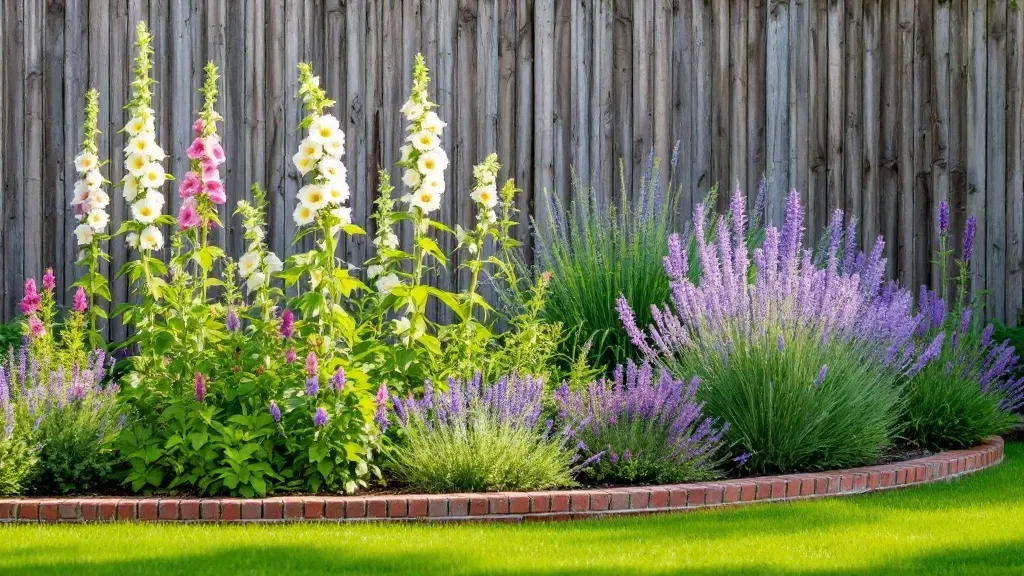
You have a strip along a fence or a lawn and no idea how deep to make it. A garden border planner answers three questions in order: how wide the border is, how tall each plant may grow, and which plants sit in front of which.
Published
What a garden border planner must show on paper
A garden border planner is a scaled drawing of one strip of ground with four things on it. The strip's length and depth, the mature height of each plant, the layer each plant sits in, and the edge. Without those four, you are buying plants and hoping.
University of Arizona Extension tells gardeners to get out the graph paper and draw the bed to scale. Its Perennial Border Design sheet says to picture the height and shape of each plant at maturity before you plant. Its example is a hollyhock, which can grow five feet high or more.
Most of the guidance below comes from perennial flower borders, because that is where extension services have written the rules down. The numbers carry over to a strip of herbs, vegetables and flowers along a vegetable plot.
A border looks right when the tall plants are at the back and the lawn can still be mowed.
Border width: let the tallest plant set the depth
Start with the plant you most want, then work out how deep the strip must be. Two extension services give two different ratios.
Arizona limits plant height to two thirds of the border width. Its example is no plants taller than four feet in a six foot wide border. A Mississippi State Extension page says to keep the width of a planting about twice the height of the tallest plant. Mississippi adds that perennial borders are often 6 to 8 feet wide.
The sums are plain. Two thirds of 6 feet is 4 feet. Half of 6 feet is 3 feet. Divide a plant's height by two thirds and you multiply by 1.5. Multiply by 2 for the Mississippi rule.
| Tallest plant | Depth needed, Arizona rule (height x 1.5) | Depth needed, Mississippi rule (height x 2) |
|---|---|---|
| 3 feet | 4.5 feet | 6 feet |
| 4 feet | 6 feet | 8 feet |
| 5 feet (a hollyhock) | 7.5 feet | 10 feet |
Choose the Arizona rule when your strip is narrow. Choose the Mississippi rule when you have the room and want the border to look full.
Layers: three bands from the fence to the lawn
Both services put the tall plants at the back. The Mississippi page says the tallest plants usually go toward the rear as a backdrop. Arizona puts tall plants in back, medium plants in the middle and short plants in front, and adds a few medium shrubs or tall perennials in the middle of the bed for pattern.
Divide the depth into three bands on your drawing. A 6 foot border gives two feet to each band. The split is a drawing aid of ours, not a rule from either service.
| Band | Depth in a 6 foot border | What goes there |
|---|---|---|
| Back | 0 to 2 feet from the fence | Tallest plants, up to 4 feet |
| Middle | 2 to 4 feet | Medium perennials and a few shrubs |
| Front | 4 to 6 feet | Low plants that frame the edge |
For choosing plants, Arizona says to choose by location first, bloom period second, height third and color last. A row of hollyhocks in front of a low shrub hides the shrub.
Groups of five to seven: how many of each plant
Single plants of ten kinds look like a collection. According to Arizona, five to seven identical small plants grouped together always look better than a random mix of small or medium plants. It calls the elongated groups drifts and the round groups clumps, and wants them to vary in size.
Count with the area. A 12 foot long, 6 foot deep border is 12 x 6 = 72 square feet. A drift of seven small plants running through the front band gives the eye one shape to follow.
Leave bare ground between plants. The same sheet says a little bare ground defines space and says not to crowd plants. Smaller plants will fill in.
Edging and mowing space
An edge keeps the border a border. Arizona suggests bricks or rocks set flush with the ground, and bold sweeping curves in place of straight lines. Mississippi lists bricks laid flat, flagstone, bare ground or a heavy layer of wood chips or bark to keep grass out.
If the border meets a lawn, Arizona says to leave enough room to mow. A flush edge lets the mower wheel ride along it.
Edibles in the front row
Many of the front-band plants can be edible. A 2024 Penn State Extension article on herbs and flowers calls lavender and rosemary traditional edging plants that can be used as a garden border, with edible flowers and fragrant foliage. The same article says sage, oregano, thyme and basil love full sun.
Put the plants you pick often at the front, where you can reach them without stepping into the bed. Check the sun each herb needs against the band it sits in, because a back band in the shade of a fence is a poor spot for a sun lover.
Timing comes from two sources. Arizona says to choose plants by location first and period of bloom second, and to aim for a continuous succession of color. Penn State says basil is an annual that can be sown by seed throughout the season, which gives a long harvest from one front-band gap.
If the front band holds vegetables, size each crop to the household. A 2020 University of Georgia Extension article says one or two cherry tomato plants will supply a family of four for the whole season, and three to five bell pepper plants are about right for the same family.
Common mistakes and mid-season fixes
Arizona names the mistakes. Tall plants in front of a low shrub hide it. Plants set too close crowd each other. Straight edges lose to bold curves and a flush brick or rock edge. Where the border meets a lawn, leave room to mow.
The fixes are cheap in a first year. The Arizona sheet says plants can be moved around, added or deleted over time, and suggests photos of the border at different times of year to see what to improve. Take one photo each month, then move the plant that hides another one when it is dormant or small. Close a gap with a basil sowing.
Flower borders and other cases a vegetable plan misses
If you plan a pure flower border, a perennial guide from your own state extension will do more for you. It lists bloom times and plants for your region, and our kits do not. Plain graph paper and the free sheets above also work, and cost nothing.
The Garden Year bundle is built for vegetable gardens, so a border is something you draw yourself on its grids. In winter you pencil it on a Winter Plan bed plan at 1 inch to 1 foot, or on the 28 by 32 foot whole-plot graph, where a 12 by 6 foot border is a 3 by 1.5 inch rectangle. Print at 100 % (actual size) so that scale holds. The Companion Planting Plan has a page on flowers in the vegetable bed. On planting day you fill in the Season Record's planting log, and after the first fall frost its variety verdicts page. Every kit counts from your own last-frost date and holds a freeze-date table for 108 NOAA stations (1991-2020 normals), so a strip in Arizona and a strip in Vermont use the same pages.
FAQ
How do I design a beautiful garden border?
Draw it to scale, keep the tallest plant under two thirds of the border depth, put tall plants at the back and short ones in front, and group five to seven identical small plants together, as University of Arizona Extension advises.
Conclusion
Measure the strip first, then let your tallest plant set the depth. Fill the border back to front in three bands, repeat each small plant five to seven times, and leave a mowing strip. Draw it on graph paper before you buy a single plant, because moving a line costs nothing and moving a hollyhock costs a weekend.
Sources
- University of Arizona Cooperative Extension, Perennial Border Design, Backyard Gardener #229 (2024), last checked October 5, 2026
- Mississippi State University Extension, Designing Perennial Plantings (undated), last checked October 5, 2026
- Penn State Extension, Edible Landscapes: Herbs and Flowers (2024), last checked October 5, 2026
- University of Georgia Cooperative Extension, How to plan your vegetable garden (2020), last checked October 5, 2026