Garden Design Planner: Site to Bed Shapes
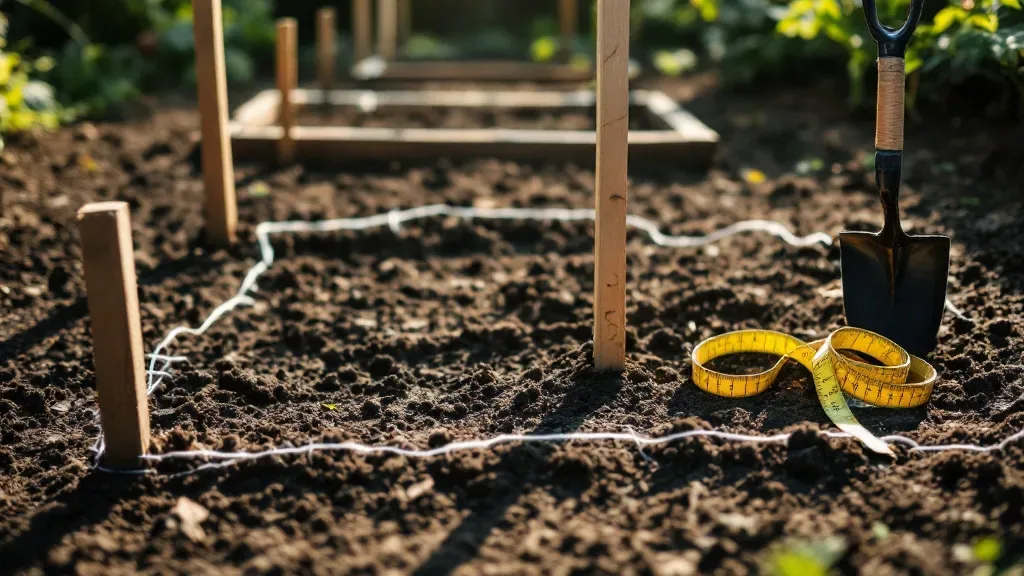
You have a patch of yard and a rough idea of where the vegetables should go. A garden design planner is a drawn plan of your site that fixes each bed's shape, its size and the paths between beds, so you can build it with a tape measure.
Published
What a garden design planner must draw
A garden design planner has to settle three things on paper. It shows the outline of your site, the sun on it, and the shape and size of every bed.
A Texas A&M AgriLife Extension publication tells gardeners to make a drawing on paper that shows the location and spacing of vegetables. It warns that making the garden too large is one of the most common mistakes of first-time gardeners, because a garden that is too large is too much work.
Draw small and honest. A plan you can build in one weekend beats a grand one you abandon in May.
A garden drawn to scale on paper is cheaper to fix than a garden dug in the wrong place.
Measure the site before you draw
Start with the outline. Measure the length and the width of the space you can actually use, and note anything fixed in it, such as a downspout, a hose bib or a tree.
Then draw the sun. Clemson Cooperative Extension says raised beds belong in a well-drained site that gets a minimum of six hours of direct sunlight a day, preferably near a water source. The Texas A&M publication adds that vegetables need sunlight to grow well, so shade from buildings and trees belongs on your drawing too.
Clemson also suggests locations you walk past daily, which makes it easy to spot problems early. Wind protection is worth a note on the drawing as well.
On a Letter sheet, 1/4 inch to the foot fits a 28 by 32 foot plot. A 20 by 30 foot plot at that scale is 5 by 7.5 inches, with room for notes around it.
Fit the beds to your reach
Bed width is the number that makes a design work. Colorado State University Extension says to design planting beds three to four feet wide and any length, and that a bed four feet wide is ideal for most vegetable crops. Clemson gives the reason: a bed should be only as wide as you can easily work from either side to the middle.
Length is up to you. A bed 8 feet long and 4 feet wide holds 32 square feet (4 x 8), and you can walk around the whole of it.
Choose paths and bed shapes together
Paths take space away from beds, so the two decisions belong together. The extension sources give different numbers, and both are fair.
| Source | Bed width | Path width |
|---|---|---|
| Colorado State University Extension (2023) | 3 to 4 feet, ideal 4 feet | 18 to 24 inches |
| Clemson Cooperative Extension (2017) | 3 to 4 feet | 3 to 4 feet for enclosed beds |
Open beds with soft edges can use the narrower paths. Enclosed raised beds are easier to work with the wider ones. A rectangle is the easiest shape to reach into and to cover, so draw rectangles first and curve nothing until the plan works.
A wheelbarrow changes the answer. An Iowa State Extension answer says paths between adjacent beds should fit garden equipment such as a wheelbarrow or cart, about 3 feet wide. A University of Georgia circular says 12 inches is the absolute minimum, 18 to 24 inches is ideal, and carts, wheelbarrows and wheelchairs need 4 feet between beds. Pick one main 3 to 4 foot path to the compost or the gate, and keep the other paths narrow.
Worked example: nine beds in a 20 by 30 foot plot
Take a plot 20 feet wide and 30 feet long, which is 600 square feet (20 x 30). Fill it with beds 4 feet wide and 8 feet long, and count how many fit for each path width.
The sum runs both ways. Across the 20 foot side, three beds and two paths use 12 feet plus the paths. Along the 30 foot side, three beds and two paths use 24 feet plus the paths.
| Path width | Beds that fit | Growing area | Share of the 600 square foot plot |
|---|---|---|---|
| 18 inches | 9 | 288 sq ft | 48% |
| 24 inches | 9 | 288 sq ft | 48% |
| 3 feet | 9 | 288 sq ft | 48% |
| 4 feet | 6 | 192 sq ft | 32% |
Nine beds of 32 square feet is 288 square feet. Moving from 3 foot paths to 4 foot paths costs you three beds, which is 96 square feet of growing space.
Place tall crops and name every bed
Once the shapes are fixed, give each bed a job. The Texas A&M publication advises grouping tall vegetables such as okra, corn and tomatoes together on the north side of the garden, where they will not shade shorter ones such as bush beans.
Write one crop family or one crop group in each bed, because you will need those labels next year when you plan where things go. Most vegetables, it says, need at least 3 feet of space between rows, so ten rows would need a garden 30 feet wide. Beds cut that waste.
A 24 foot row of carrots, Colorado State University Extension notes, fits into a bed 3 feet by 2 feet. That is why a plot full of short rows turns into a handful of compact beds on paper.
The most efficient vegetable garden layout
Blocks beat rows for a home vegetable garden. Colorado State University Extension says block-style layouts increase yields fivefold compared to the traditional row-style layout, and fifteen-fold for the smaller kitchen garden vegetables.
The technique is to eliminate unnecessary walkways by planting vegetables in rectangular beds instead of long single rows. Your nine-bed plan already does this.
How big for your household
Bed count follows appetite, so size the plan to the table you feed. A 2020 University of Georgia Extension article gives amounts for a family of four. One or two cherry tomato plants cover the whole season, three to five bell pepper plants are about right, and three or four hills of squash at each planting keep up with dinners. It also says to plant three or four cucumber hills, or a few 10 to 15 foot rows of green beans.
Give each of those crops a share of a bed and write the count on the plan beside it. The extension article gives no per-person rule, so scale the family-of-four amounts to the people at your table.
Looks and work: how to balance them
Good looks and a good harvest come from the same drawing. The University of Florida IFAS Extension page on foodscaping says the main appeal of edible plantings is that they are useful and beautiful, so develop a design before planting. It offers a formal garden with straight edges or a more natural one with organic shapes, and neat edges from walls, edging, curbing or raised planters. Its lettuce border along a bed is a small step, and it advises paths that connect plantings and make plants easier to access.
Take the rectangles from this plan for the work, and spend the looks on the edges and the front of each bed. Rectangular beds stay easy to reach. A row of lettuce along the path edge costs you no growing area.
Mistakes that show up on paper
Draw them out before you dig. A garden that is too large is the first, and the Texas A&M publication calls it one of the most common mistakes of first-time gardeners. Tall crops placed where they shade short ones are the second, which is why the same publication puts them on the north side. Paths too narrow for a wheelbarrow are the third.
Fixing a mistake is cheap on paper and costly in soil. We found no extension source for rescuing a poor layout mid-season, so treat the drawing as the place to get it right, and redraw it as often as you like.
Cases where graph paper is all the design you need
Plenty of gardens need nothing more than a sheet of graph paper and a pencil. Renting a community plot with fixed bed sizes, or growing only in a few containers, leaves you almost no design decisions. Free extension charts cover bed width and paths, as the sources above show. A printed set also cannot show a garden in three dimensions or let you drag a bed on a screen, so gardeners who design that way will like a drawing program.
Printed pages earn their place when you want to draw by hand and keep the drawing with your records. The Winter Plan has a yard and sun map on a dot grid, with a sun check, and bed plans at true scale where 1 inch stands for 1 foot, so print at 100 % (actual size). Beds come in 4 by 8, 4 by 4, 3 by 6 and 2 by 8, plus a custom 3 by 8. A whole-plot graph at 1/4 inch to the foot covers a 28 by 32 foot plot, so the 20 by 30 foot example fits with room to spare.
The pages are used in order. In winter you fill the sun map and bed plans, and before planting the rotation planner (10 beds over 4 years). Then the spring week list runs from 14 weeks before frost to 3 weeks after. Dates count from your own last-frost date, and a table of freeze dates (10, 50 and 90 %) for 108 NOAA stations makes it work in any US zone. Print the dot grid first, mark your fixed objects and your sun, and see whether the shapes fall into place.
FAQ
What is the most efficient garden layout?
For vegetables, block-style beds beat single long rows. Colorado State University Extension says block layouts increase yields fivefold compared to row-style gardens. Plant in rectangular beds 3 to 4 feet wide, any length, and drop the extra walkways between rows.
Conclusion
Measure the plot, draw the sun, and size every bed to the length of your arm before you pick a single crop. Beds 4 feet wide with paths you can walk comfortably turned a 20 by 30 foot plot into nine working beds in the example above. Draw yours small on paper first and move the shapes until the paths feel right.
Sources
- Colorado State University Extension, Block Style Layout in Raised Bed Vegetable Gardens (2023), last checked October 5, 2026
- Clemson Cooperative Extension Home and Garden Information Center, Raised Beds (2017), last checked October 5, 2026
- Texas A&M AgriLife Extension, Easy Gardening: Planning a Garden E-289 (2011), last checked October 5, 2026
- University of Georgia Cooperative Extension, How to plan your vegetable garden (2020), last checked October 5, 2026
- University of Georgia Cooperative Extension, Raised Garden Bed Dimensions, Circular 1027-4 (2022), last checked October 5, 2026
- Iowa State University Extension and Outreach, Raised bed size and construction (2024), last checked October 5, 2026
- University of Florida IFAS Extension, Foodscaping (undated), last checked October 5, 2026