Garden Planner Worksheet: Every Row Explained
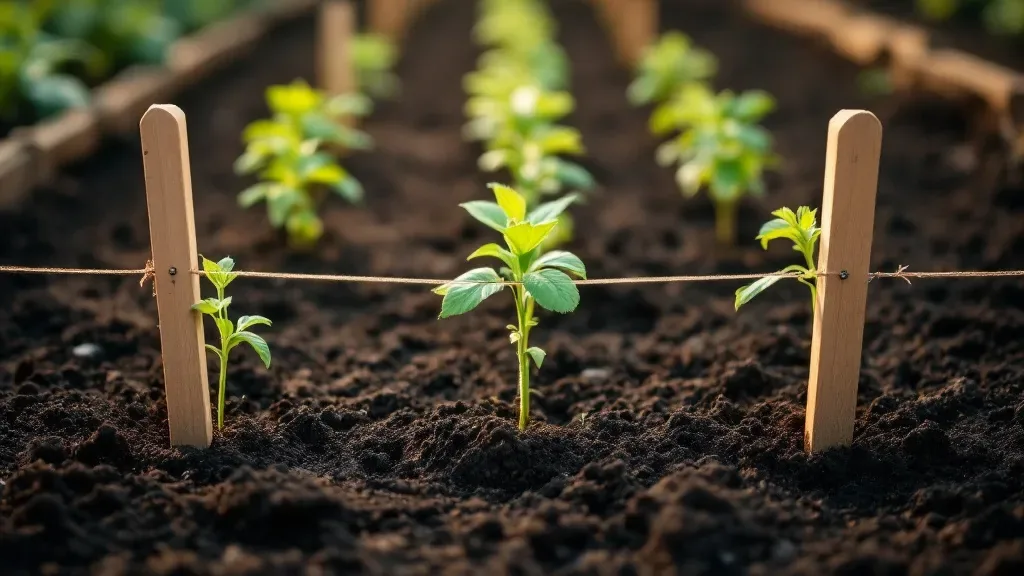
You have a blank sheet and a seed catalog. A garden planner worksheet is a table with one row per crop and one column per decision, and each column below says what to write in it.
Published
What a garden planner worksheet holds
A garden planner worksheet answers the questions a University of Delaware fact sheet lists for a paper plan. Delaware Cooperative Extension says to determine the shape, length and width of the garden, the space between rows, the vegetables in each row, and the late vegetables that follow the early ones. It adds that a rough sketch will do, but it must be fairly accurate to be useful.
Extension charts are built from the same columns. The Kansas State planting guide lists days to first harvest, plants per 10-foot row, spacing within and between rows, and frost resistance for each crop. The University of Georgia chart adds spring and fall planting dates and seeds per 100 feet. Six columns cover all of it.
| Column | What you write | Where the number comes from |
|---|---|---|
| Crop | Name and variety | Your seed list |
| Frost resistance | Hardy, half-hardy, tender or very tender | Kansas State labels every crop with one of these |
| Plant date | The week you sow or set out | Your own last-frost date and your state's chart |
| First harvest | Plant date plus days to first harvest | Kansas State and Georgia list the days |
| Space per plant | Inches within the row and between rows | Kansas State lists both |
| Amount | Plants or feet of row | Kansas State lists plants per 10-foot row and per person |
A planting plan is a set of small decisions, written down before the weather makes them for you.
Frost resistance: the column that groups your rows
In the Kansas State guide, peas are hardy and beets are half-hardy. Bush beans, pole beans, peppers and tomatoes are tender, and cucumbers and melons are very tender. Write the class in each row first, then sort the rows so crops with the same class sit together. The sorted list shows which crops can share a planting week and gives you an order of work.
The date column is where a copied chart goes wrong. Georgia's chart gives spring bush beans a window of March 15 to May 1, and tomatoes March 25 to May 1. Those are Georgia dates. The Kansas State guide warns that its planting windows may need to be adjusted earlier or later depending on the weather each season, the varieties you choose and your location.
To get a plant date from your own last frost, count backward. A University of New Hampshire Extension post says tomato seeds start indoors six to eight weeks before the last frost, and a University of Illinois Extension post says broccoli starts 4 to 6 weeks before the average last frost. With a last frost of May 1, six weeks back is March 20 and eight weeks back is March 6, so a tomato row reads "March 6 to March 20". Broccoli reads "March 20 to April 3". Then add the first-harvest days from the next column.
Copy the method from an extension chart, then write your own dates in pencil. The Winter Plan in The Garden Year bundle counts its dates from your own last-frost date instead of one fixed zone.
First harvest: the plant date plus a range
University of Wisconsin Extension explains the days-to-harvest number. For crops started in the garden, such as beans and carrots, it counts from seeding to first harvest. For crops you set out, such as tomatoes, it counts from transplanting to first harvest.
Write a range, because charts disagree. Bush beans get 50 to 60 days from both Kansas State and Georgia. For pole beans Kansas State says 55 to 70 and Georgia says 65 to 75.
Take bush beans sown on May 10. Fifty days later is June 29 and sixty days later is July 9, so you write "June 29 to July 9" in the row. Pole beans sown the same day at Kansas State's 55 to 70 days run from July 4 to July 19.
Space per plant: the column that tests your bed
Spacing is the column most worksheets skip, and the one that tells you whether the plan fits. Kansas State lists the average spacing within the row and between rows for each crop. Multiply them, divide by 144, and you have square feet per plant at the low and high end.
| Crop | Within row x between rows (in.) | Square feet per plant |
|---|---|---|
| Bush beans | 3 to 5 x 36 | 0.75 to 1.25 |
| Pole beans | 6 to 12 x 48 to 60 | 2 to 5 |
| Peppers | 12 to 24 x 36 | 3 to 6 |
| Tomatoes | 24 to 36 x 36 to 48 | 6 to 12 |
| Cucumbers | 24 x 48 to 72 | 8 to 12 |
A 4 by 8 foot bed holds 32 square feet (4 × 8). Divide by 12 and you fit 2 tomato plants. Divide by 6 and you fit 5.
Raised beds usually let you plant closer than row spacing. Treat the table as the roomy end of the range, and note your tighter choice in the row.
Amount: the column where the plan fails on paper
The guide suggests 3 to 5 tomato plants per person. A household of four writes 12 to 20 in the amount column (3 × 4 and 5 × 4). At 6 to 12 square feet each, those plants need 72 to 240 square feet (12 × 6 and 20 × 12).
A sum that overshoots the bed is the finding a worksheet exists to produce. The same guide says even a 100-square-foot garden can produce a good portion of the vegetables for a family of four, so tomatoes alone can outgrow a small plot. Cut the amount, choose smaller plants, or move some of them to another bed.
Add the amount column for every row before you buy seed. The total of the square feet column is your honest garden size.
The map: one scale for every row
The last piece is a drawing. Delaware suggests making the plan to scale if possible, using 1/8 inch to 1 foot. A 20 by 30 foot plot then measures 2.5 by 3.75 inches (20 ÷ 8 and 30 ÷ 8), which fits in a corner of a notebook page.
Give each bed a letter and write that letter in the worksheet row. The row says what and how many, and the map says where.
Record what happened beside the plan
A worksheet earns its place twice. In winter it holds the plan, and in summer it holds the results. Next to each planned row, write the date you really planted, the date of the first pick and a one-word verdict.
The Season Record in The Garden Year has a planting log and a harvest tally for this. A spare column on your own sheet works as well, if you will keep filling it in.
Use the columns at set moments. Fill the plan columns in winter. On sowing day, write the real date in the planned row. At the first pick, write the date and the one-word verdict. At the end of the season, sum the amounts you really got and compare them with the amounts you wrote in winter.
Fixing a row in midsummer
A row that does not match the garden is a normal finding. If plants come up too thick, thin them. The University of Maryland says that failure to thin seedlings will stunt plant growth and reduce the harvest, so cut the extras to the spacing in your row.
If an early crop finishes and leaves a gap, change its row. A University of Maryland page on succession planting describes it as planting seeds or transplants in spots vacated by spent plants. Add a new row for the crop that follows, with its own plant date and first-harvest range. If the square feet total from your amount column was too big, cross out the extra plants now and note why.
When your state's own chart is enough
A printed kit is the wrong purchase for some gardeners. If your state extension publishes a planting chart for your area, the date column is already answered, and a free chart plus a notebook is all you need. A single bed of tomatoes and peppers also fits on a sticky note.
Extension charts such as Kansas State's and Georgia's give dates for their own states only. A worksheet pays off when you grow many crops, work in more than one bed, or want next year's plan to start from this year's results. In the kits, the Winter Plan's master chart holds the 41 crops and its seed order calculator turns amounts into packets, while the Season Record's planting log, harvest tally and yield-against-plan page take the real dates and pounds.
FAQ
How do I plan a garden layout?
Sketch the garden to scale, and the University of Delaware suggests 1/8 inch to 1 foot. Mark its shape, length and width, the space between rows, the vegetable in each row and the late crops that follow the early ones. Check each crop's spacing against your state's extension chart before you draw.
Conclusion
Fill one row before you fill twenty. Pick the crop you care about most, write its frost resistance, first-harvest dates, spacing and plant count, then check the sum against the square feet you really have. If the row does not fit your bed on paper, it will not fit in soil, and paper is the cheaper place to find out.
Sources
- University of Delaware Cooperative Extension, Planning a Vegetable Garden (2004), last checked October 5, 2026
- Kansas State University Research and Extension, Vegetable Garden Planting Guide MF315 (2023), last checked October 5, 2026
- University of Georgia Cooperative Extension, Vegetable Planting Chart C963 (undated), last checked October 5, 2026
- University of Maryland Extension, Sowing Vegetable Seeds Outdoors (undated), last checked October 5, 2026
- University of Maryland Extension, Planting Vegetables in Succession (undated), last checked October 5, 2026
- University of New Hampshire Extension, How do I know when to start seedlings indoors? (2018), last checked October 5, 2026
- University of Illinois Extension, When should I start my seeds? (2023), last checked October 5, 2026
- University of Wisconsin Extension, The Vegetable Garden A1989 (undated), last checked October 5, 2026