Herb Garden Layout Planner: Which Herbs Share a Bed
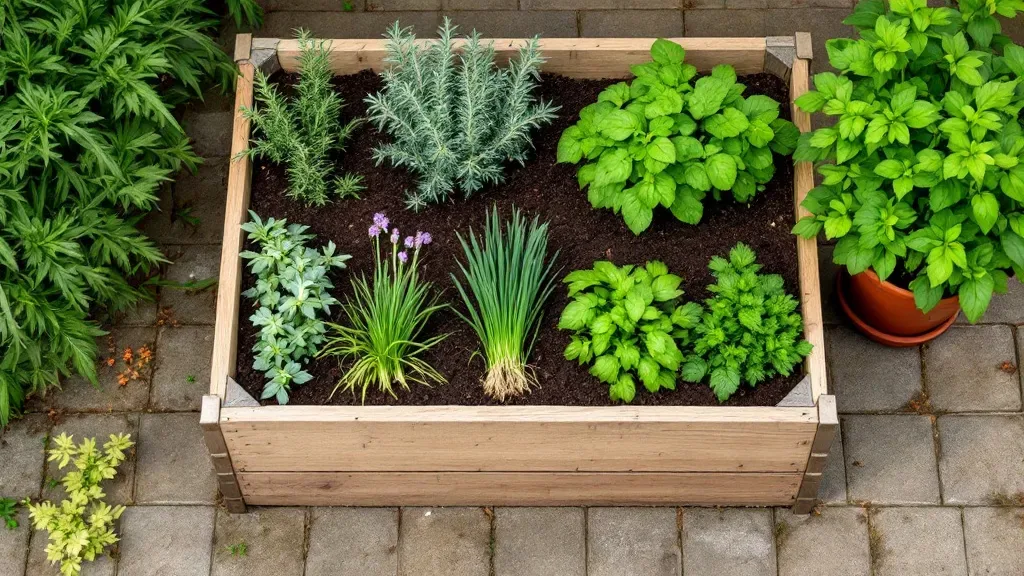
You have a bare bed, a tray of herb seedlings and no idea who should sit next to whom. An herb garden layout planner is a bed drawn on paper in groups, with each herb set at its spacing, the dry-side herbs together and the thirstier ones together, and mint kept in a pot.
Published
Build your herb garden layout planner from three groups
Start by sorting your herbs into groups, not by drawing squares. Colorado State University Extension, writing about herbs in containers, says combinations should have similar water and light needs. It sorts the common kitchen herbs into two moisture groups, and Oregon State University Extension adds a third question: how long the plant lives.
A Colorado State PlantTalk page on herbs in containers says parsley, chives and oregano need more moisture than others. It says the Mediterranean herbs, such as sage, rosemary and thyme, need less. Oregon State's Growing Herbs handout says annual herbs such as basil grow and bloom for one season and then die, while perennial herbs come back for several years.
Three groups go in the bed and one herb goes in a pot.
| Group | Herbs | Why they sit together |
|---|---|---|
| Dry side, perennial | Sage, rosemary, thyme | Need less moisture (Colorado State) |
| Moister side | Oregano, chives, parsley | Need more moisture (Colorado State) |
| Annual strip | Basil, coriander | Die after one season (Oregon State), so replant the same spot each year |
| In a pot | Mint | Spreads aggressively (Colorado State, Oregon State) |
Herbs that drink alike should grow beside each other.
Which herbs share a bed, and which stay apart
Mint is the one herb to keep out of the bed. A few herbs, such as mint, need to be contained or they will overtake a garden, says Oregon State. Plant runaways in a container, or sink a pot into the ground to just below the rim. Choose a pot large enough to confine the roots for a couple of years.
Dry-side and moist-side herbs should stay in separate zones. Put rosemary next to parsley and one watering schedule has to serve two plants with different needs. Keep the two groups in their own bands.
Check the life cycle too. The University of California Master Gardeners of Orange County list parsley as a biennial, and sage and thyme as perennials that need renewing: renew a sage bed every 3 to 4 years, and start new thyme plants every 3 to 4 years. A perennial corner you rarely dig is the right home for them. Basil goes where you can replant each spring.
The extension pages used here name no herb pair as a proven bad neighbor beyond these cases. Moisture, light and spread are the three reasons they give.
Spacing for 11 herbs, in inches
Spacing decides how many plants fit. The University of California Master Gardeners list the distance between plants for each herb in their Use and Culture of Culinary Herbs chart. The table copies the figures for 11 herbs.
| Herb | Space between plants (in) | Height | Life cycle |
|---|---|---|---|
| Parsley | 6 | 5 in | Biennial |
| Oregano | 9 | 24 in | Perennial |
| Basil | 12 | 20 to 24 in | Annual |
| Chives | 12 | 12 in | Perennial |
| Rosemary | 12 | 3 to 6 ft | Perennial |
| Sage | 12 | 18 in | Perennial |
| Thyme | 12 | 8 to 12 in | Perennial |
| Coriander (cilantro) | 18 | 24 in | Annual |
| Fennel | 18 | 60 in | Perennial |
| Mint (peppermint, spearmint) | 18 | 18 to 36 in | Perennial |
| Tarragon | 24 | 24 in | Perennial |
Two herbs from the same chart need little room. The chart says one rosemary plant is enough for a home garden, and parsley needs only a few plants. Plan for one rosemary and three parsley, not a row of each. The chart gives no count by household size, so start with these and add a plant only if you run out.
Height matters for placement. Rosemary reaches 3 to 6 feet and fennel 60 inches, so put the tall ones where they will not shade the low ones. Parsley is listed as needing some shade, which makes it a good neighbor for something taller.
A worked 4 by 4 foot herb bed, with the arithmetic
A 4 by 4 foot bed is 16 square feet. The plan below uses three bands across the bed and a pot of mint beside it.
The bands are 6, 6 and 4 square feet, which adds to 16. To count what each herb uses, treat every plant as a square as wide as its spacing. A 12-inch herb takes 1 square foot. Oregano at 9 inches takes 0.56 square foot, and parsley at 6 inches takes 0.25.
| Herb | Plants | Space each (sq ft) | Total (sq ft) |
|---|---|---|---|
| Rosemary | 1 | 1 | 1 |
| Sage | 1 | 1 | 1 |
| Thyme | 2 | 1 | 2 |
| Oregano | 2 | 0.56 | 1.1 |
| Chives | 1 | 1 | 1 |
| Parsley | 3 | 0.25 | 0.75 |
| Basil | 3 | 1 | 3 |
| Total | 13 | 9.9 |
Thirteen plants use about 10 of the 16 square feet, which leaves 6 square feet empty. Keep it empty at first, since the plants will fill in, or use it for a second planting of basil. The spacing figures come from the California chart, while the squares and the bands are arithmetic you can change for your own bed.
You can draw this plan on a sheet before you plant. The bed plans in The Winter Plan print at true scale, 1 inch to 1 foot, so a 4 by 4 foot bed is a 4 inch square on the page.
Sun, soil and picking
Give the bed at least 6 hours of sun. Per Oregon State, herbs in general need full sun but will thrive on as little as 6 hours a day. Drainage is, in that handout's words, probably the single most important factor in successful herb gardening, because herbs stall and may die in soggy soil.
Skip the heavy feeding. According to Oregon State, highly fertile soil tends to produce a lot of foliage with little flavor, so it advises little or no fertilizer for most herbs. Chervil, fennel, lovage and summer savory are named as exceptions that want moderate amounts.
Pick the right way so the layout stays full. For a major harvest, Oregon State says annual herbs may be cut at ground level, while perennials should be cut down by only about a third of their size. Pick in the morning, after the dew has dried and before the sun gets hot.
Herb bed mistakes and what to do mid-season
Mixing thirsty and dry herbs is the first. Colorado State says combinations need similar water and light. If rosemary already sits beside parsley, move one of them into its own band when you next divide or replant.
Planting mint in the open bed is the second. Oregon State says a few herbs, such as mint, overtake a garden. If it has already spread, lift it and sink a pot into the ground to just below the rim.
Soggy soil is the third. Oregon State calls drainage probably the single most important factor in herb gardening, because herbs stall and may die in soggy soil. Feeding too much is the fourth. Rich soil grows leaves with little flavor, the same handout says, so skip the fertilizer for most herbs.
Cutting too hard is the fifth. Take perennials down by about a third of their size at a time, as Oregon State advises. The California chart adds that sage beds want renewing every 3 to 4 years, so write the year you planted them.
A windowsill herb pot needs no bed plan
If your herbs live in pots on a sill or a balcony, you do not need a bed layout. A pot of one herb only needs a pot big enough for its roots, and the free extension pages linked here cover that case. The spacing table above is also free to print.
A printed layout helps when the herb bed sits next to tomatoes, beans and lettuce and you want everything on one map. The Winter Plan has a whole-plot graph and bed plans for that, so a 4 by 4 foot herb bed is a 4 inch square on the page. Draw the bed in winter, check the sun on its sun map, mark planting week on the spring week list, and note on the succession waves page when basil gets replanted. Basil and coriander dates count from your own last-frost date, and each kit holds freeze dates for 108 NOAA stations, so any US zone works.
FAQ
What is the best layout for a herb garden?
Group herbs by water and light, give each its spacing, and keep mint in a pot. Colorado State Extension says combinations should have similar water and light needs. Sage, rosemary and thyme need less moisture, while parsley, chives and oregano need more.
What herbs shouldn't be planted together?
Keep mint apart from everything, because Oregon State Extension says it needs to be contained or it will overtake a garden. Also avoid putting a thirsty herb such as parsley next to a dry-side herb such as rosemary, since Colorado State Extension says their moisture needs differ.
What herbs grow well together chart?
Herbs that need less moisture grow well together: sage, rosemary and thyme. Herbs that need more moisture make a second group: parsley, chives and oregano, according to Colorado State Extension. The table in this article lists both groups with spacing.
Conclusion
Draw your bed before you buy plants. Group the herbs by water, give each one its spacing from the table, and put mint in a pot. Leave the empty squares empty for the first season, since most of these herbs fill in fast.
Sources
- University of California Cooperative Extension Master Gardeners of Orange County, Use and Culture of Culinary Herbs (undated), last checked October 5, 2026
- Colorado State University Extension, PlantTalk Colorado: Growing Herbs in Containers (undated), last checked October 5, 2026
- Oregon State University Extension Service and Oregon Master Gardener Association, Growing Herbs (undated), last checked October 5, 2026