Kitchen Garden Planner: Grow What You Use
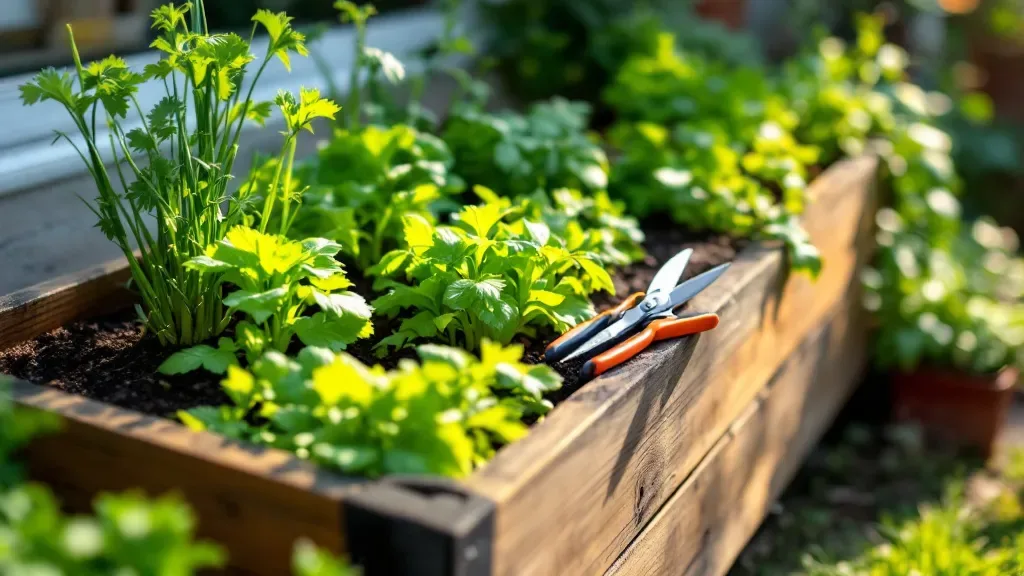
You want fresh herbs and salad within a few steps of the stove. A kitchen garden planner is a one-page plan that puts the crops you pick most often nearest the door and gives each one a sowing rhythm of 7 or 14 days.
Published
Where a kitchen garden belongs
Put the bed where you will walk past it. A Rutgers extension article says a garden close to your home means more weeds pulled, more vegetables harvested and plants watered more often when you can see it from the house.
Virginia Tech Extension gives the same advice in practical terms. Its planning guide says to choose a spot near your home so it is convenient to work when you have a few minutes. It also asks for at least 6 hours of sun, with 8 to 10 hours ideal, and an easy supply of water.
Sun still wins over distance. A bed by the door with fewer than 6 hours of sun misses that minimum, so move the plan to the sunniest spot you can reach in a few steps.
A kitchen garden works because you can pick from it while the pan heats.
Sort crops by how often you pick them
Make a list of what you cook with in a normal week, then rank it. The crops you snip several times a week earn the spot by the door. The ones you pick once a month can sit farther out.
Three groups fall out of that list, and each one gets its own rhythm.
| Group | Crops | How it is sown |
|---|---|---|
| Fast salad crops | Leaf lettuce, radish, spinach, cilantro | Every 7 days |
| Slower herbs and roots | Parsley, basil, dill, beets, turnips | Every 14 days |
| Perennial herbs | Chives, thyme, sage, mint | Once, then left in place |
The 7-day and 14-day groups come from a University of Kentucky Cooperative Extension succession planting guide, which also puts head lettuce and bush beans at 10 days and cucumbers and carrots at 21. A University of Connecticut herb fact sheet calls chives, thyme, sage and mint perennials, and basil an annual. Parsley is listed as annual or biennial.
How many plants a household needs
Virginia Cooperative Extension has a table of plants per person for each crop. Its home garden planting guide says children may need half the amount an adult does, and that you should grow more of a crop if you plan to can or freeze it. The counts are per planting, and Virginia spaces plantings two to three weeks apart for a continuous harvest.
| Crop | Plants per person per planting | Two adults, one planting |
|---|---|---|
| Lettuce, head | 5 to 10 | 10 to 20 |
| Lettuce, baby salad | 10 to 15 ft of row | 20 to 30 ft of row |
| Spinach | 15 | 30 |
| Radish | 2 ft of row | 4 ft of row |
| Beets | 10 to 20 | 20 to 40 |
| Chard | 3 to 5 | 6 to 10 |
The last column is plain multiplication by two. The table has no line for parsley, basil, dill or chives, so no extension number is given here for herbs. Start with one or two plants of each herb you cook with and add more if you run short.
A weekly rhythm sows more often than Virginia's two to three weeks. That is this article's own reading of the table: sow a smaller share each time, so the bed never fills with lettuce at once.
A sowing rhythm you can run on Saturdays
Pick one sowing day a week and fix it in your plan. Sow the 7-day group on every one of those days, and the 14-day group on every second one.
The arithmetic is short. Over 8 weeks you have 8 weekly sowing days. The 7-day group is sown on all 8, and the 14-day group on 4 of them. That is 12 sowing rounds from a single rule.
The table shows where the 12 comes from.
| Group | Sowing days used in 8 weeks | Rounds |
|---|---|---|
| 7-day crops | Every Saturday | 8 |
| 14-day crops | Every second Saturday | 4 |
| Perennial herbs | None after planting | 0 |
| Total | 12 |
The University of Maryland Extension agrees with the spirit of it. Its succession page says to plant a portion of that space every two weeks, so you never fill the whole bed at once.
Dates come last. Your first Saturday is set by your own last-frost date, and a plan that counts from it, such as The Garden Year bundle, gives each round a real week number.
Mixing herbs, greens and vegetables in a small bed
A University of Connecticut herb fact sheet says herbs can be grown alongside vegetables and flowers, in a dedicated herb garden or in containers. So one bed can hold all three. Three habits keep it tidy.
Sow a fast crop beside a slow one. Maryland says to sow a long-season crop such as carrot and a short-season one such as radish at the same time, then harvest the radishes before they crowd the carrots.
Hold the spreaders back. Connecticut says mint can run rampant, and suggests a bottomless five-gallon bucket sunk in the ground with the top couple of inches showing.
Add a few flowers. Maryland says clusters of small flowers attract pollinators and the natural enemies of garden pests.
What a kitchen garden planner holds on one page
Plan the bed in this order, and the page fills itself.
- Mark the door, the path and the sunniest bed within a few steps of it.
- Write down the 8 to 10 crops you actually cook with.
- Rank each one by how many times a week you pick it.
- Assign each crop to the 7-day, 14-day or perennial group.
- Write your Saturday sowing days on the page and tick each one off.
Keep the plan small. A bed you can reach from the path in one step will be weeded, and a larger one will drift.
Mistakes to avoid and fixes for midsummer
Squash is the first mistake. A single squash plant takes the space of an entire salad row and gives you one thing to cook. Grow it in a vegetable plot farther from the door.
Cutting too hard is the second. Connecticut says to take only about one third of the foliage at each harvest, and to prune basil regularly and not let it flower. Pick a little from many plants.
A glut is the third. Maryland warns that relay plantings can bring a glut at the height of the season, so be ready to process the harvest. The fix is a smaller sowing next time.
Empty ground is the fourth. When the radishes and lettuce finish, Maryland says to plant squash, bean and cucumber plants in the space cool-weather crops left. In a door bed, choose bush beans or a cucumber on a trellis.
A tiny kitchen plot may not need a full plan
If your kitchen garden is two pots of basil on a porch, a note on the fridge with two sowing dates does the job. The 7 and 14 day intervals above and Virginia's plant counts are free, and a county extension calendar may already give your sowing weeks.
A printed plan earns its place when you run a door bed and a larger plot and want the sowing weeks, bed map and harvest log in one file. The Garden Year counts from your own last-frost date and carries a freeze-date table for 108 NOAA stations, so it works in any US zone. Choose actual size when you print, so the bed grids stay at true scale.
FAQ
How do I plan a kitchen garden?
Pick a sunny spot close to the kitchen with at least 6 hours of sun. List the crops you cook with, sort them by how often you pick them, and put the most-picked ones nearest the door. Then give each fast crop a sowing interval of 7 or 14 days and leave perennial herbs in one place.
Conclusion
Draw the bed nearest the door first, and fill it with the crops you pick most. Sow the 7-day group every Saturday and the 14-day group every second Saturday, and leave the perennial herbs alone. Over 8 weeks that makes 12 sowing rounds, and your plan only needs to show which crop gets which one.
Sources
- Virginia Tech Cooperative Extension, Planning the Vegetable Garden (undated), last checked October 5, 2026
- Rutgers New Jersey Agricultural Experiment Station, Choosing the Right Location for Your Vegetable Garden (2020), last checked October 5, 2026
- University of Kentucky Cooperative Extension, Succession Planting (undated), last checked October 5, 2026
- University of Connecticut Home and Garden Education Center, A Guide to Growing Herbs (2016), last checked October 5, 2026
- Virginia Cooperative Extension, Virginia's Home Garden Vegetable Planting Guide, 426-331 (2025), last checked October 5, 2026
- University of Maryland Extension, Vegetable Succession and Companion Planting (2026), last checked October 5, 2026