Outdoor Garden Planner: Map Your Whole Yard
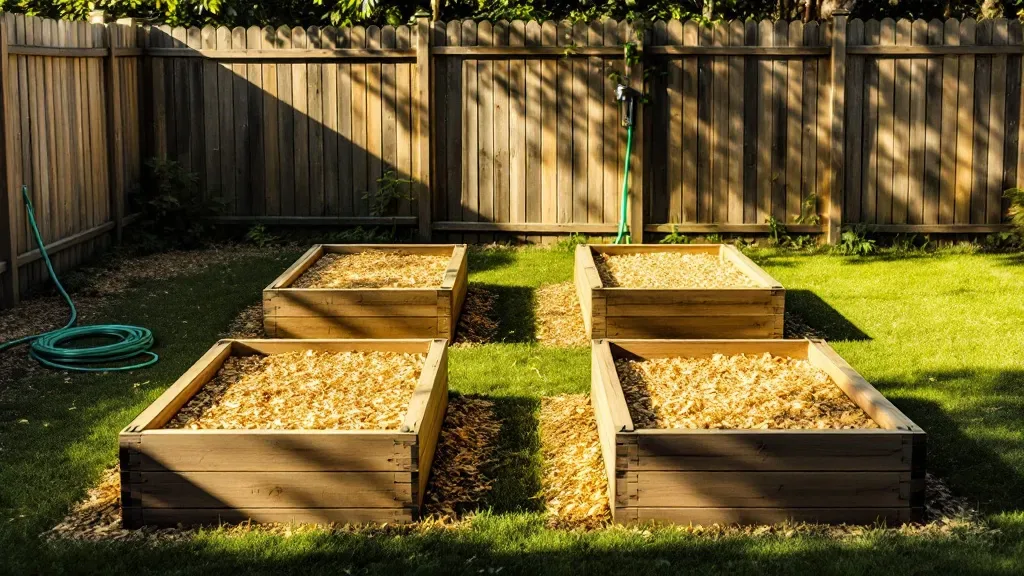
You have a whole yard and no idea where the vegetables should go. An outdoor garden planner is a scaled sketch of your yard that fixes four things in order: where the sun falls, where the beds sit, how wide the paths are and how the water gets there.
Published
What an outdoor garden planner needs to hold
A yard plan answers four questions in a fixed order. Where is the sun, where do the beds go, how wide are the paths, and where does the water come from.
The order matters. A 2010 Washington State University Extension manual says a vegetable site needs four things: full sunlight, easy access to water, protection from heavy winds and soil with good tilth. Sun and water are the two you cannot fix later. Soil you can improve every year.
A yard plan is a list of fixed things first and plants second.
You do not need a design program. A sketch on graph paper with your fence, house, trees and spigot on it is enough. Everything below goes on that one sheet.
Map the sun before you draw a bed
Walk the yard at three times of day and mark where the shade lies. Do it on a clear day, and repeat it later in the season if you can.
Virginia Cooperative Extension says vegetables grow best with at least six hours of sun, and eight to ten hours is ideal. The same publication advises watching the shading patterns through the growing season before you start, if you can. Trees, buildings and solid fences all cast shade, so mark each one.
Add up the sunny hours for each patch of the yard and write the number on the sketch. Then match crops to patches. Virginia's publication splits crops into two groups.
| Sun on the spot | Crops that fit | Source |
|---|---|---|
| 8 hours or more | Tomatoes, peppers, corn, cucumbers, beans, squash | Virginia Cooperative Extension |
| 6 hours | Lettuce, spinach, kale, chard, beets, carrots, radishes | Virginia Cooperative Extension |
Fruit and seed crops want the eight hours. Leafy crops and many root crops accept six. A 6-hour corner is not wasted. Plant lettuce there and keep the tomatoes in the brightest spot.
Read the slope, the trees and the low spots
Virginia's planning guide has a short list of site cautions. On sloped or hillside sites, use contour rows, terraces or raised beds to avoid erosion. South-facing slopes are warmer and less subject to damaging frosts.
Avoid a low spot, the base of a hill, or the foot of a slope bordered by a solid fence. Cold air drains into those places, so they warm slowly in spring and frost settles there. Avoid windy locations too, or build or grow a windbreak.
Trees and shrubs compete with vegetables for nutrients and water and may cast too much shade. Sites too close to buildings may not get enough sun. Mark each tree and its shade line on the sketch, and keep the beds out from under them.
The guide says nothing about drainage tests, so none is given here. It does ask for loose, well-drained soil, so a bed that stays soggy is a site to skip.
Lay out beds you can reach from the path
Make beds narrow enough to work from the edge. The Washington State manual says raised beds are usually 3 to 4 feet wide and 10 feet long or longer, and that you should be able to reach the middle while kneeling or sitting on either side. A bed against a fence needs to be narrower, because you can only reach it from one side.
Never walk on a bed. Do your planting, weeding, watering and harvesting from the path, so the soil in the bed stays loose.
Virginia's advice for the whole yard is to place tall and trellised crops on the north side. Corn, pole beans and tomatoes on stakes then do not shade the lettuce. Put crops from the same family in a different bed each year. The Virginia publication says not to plant a family in exactly the same place more often than once in three years.
Beds you can reach from the edge never get stepped on.
How many plants the beds must hold
The yard plan only works if the beds are sized for what you eat. Virginia Cooperative Extension's planting guide gives plants per person per planting and says children may need half an adult's amount. Multiply by the adults in your house.
| Bed type | Crop | Plants per person | Two adults |
|---|---|---|---|
| Tall crops, 8 hours of sun | Tomatoes | 2 to 4 | 4 to 8 |
| Tall crops, 8 hours of sun | Peppers | 3 to 5 | 6 to 10 |
| Tall crops, 8 hours of sun | Pole beans | 3 to 5 | 6 to 10 |
| Short crops, 6 hours of sun | Head lettuce | 5 to 10 | 10 to 20 |
| Short crops, 6 hours of sun | Beets | 10 to 20 | 20 to 40 |
| Short crops, 6 hours of sun | Carrots | 10 to 30 | 20 to 60 |
Check the guide's spacing columns against your bed width before you commit. Virginia also says to grow more of a crop if you plan to can or freeze it.
Size the paths for a wheelbarrow
Make the main paths at least 3 feet wide. That figure comes from the Washington State manual, and it leaves room for a wheelbarrow. The manual adds a second test for paths between raised beds. If you work on your knees, measure from your kneecap to the tip of your shoe, and make the path at least that wide.
Use 3 feet for every path in your first plan. You can narrow a side path later, but widening one means moving a bed.
Cover the paths. Lay heavy cardboard first, as the manual suggests, and then wood chips, straw or pine needles. The mulch keeps weeds down and keeps your feet clean and dry. Scrape the old mulch into the beds every 2 to 3 years and lay fresh mulch on the path.
Put the water on the map
Mark the spigot on your sketch before you place a single bed. Washington State says the easiest way to irrigate is from a spigot in or near the garden, and that it can be worth extending the line to bring one closer.
Then work out how much water the plan needs. The same manual says most vegetable crops need 1 inch of water a week, counting rain, and that 1 inch over 1 square foot is 0.62 gallons. Multiply your bed area by 0.62. Paths do not count, because nothing grows in them.
Soaker hoses and drip lines help. Washington State says soaker hoses can cut water use by up to 50 percent compared with sprinklers, because they water the soil and not the weeds or the air. Virginia adds that sandy soil may need 2 inches a week, so check your own soil with a trowel.
A worked yard: four beds in 17 by 25 feet
Take four beds, each 4 by 8 feet, set in two rows of two. Leave a 3-foot path between the beds and a 3-foot path around the outside. All the sums are plain arithmetic from the figures above.
| Measure | Sum | Result |
|---|---|---|
| Width of the plan | 3 + 8 + 3 + 8 + 3 | 25 ft |
| Length of the plan | 3 + 4 + 3 + 4 + 3 | 17 ft |
| Bed area | 4 beds x 4 ft x 8 ft | 128 sq ft |
| Whole plan | 25 ft x 17 ft | 425 sq ft |
| Share that is bed | 128 / 425 | about 30 percent |
| Water at 1 inch a week | 128 sq ft x 0.62 gallons | about 79 gallons |
The path space looks wasteful on paper. It is the space that lets you reach every plant and roll a barrow through. About 30 percent of this yard is bed, and every plant in it is within an arm's reach of a path.
The 79 gallons a week is the no-rain figure. Rain counts toward the inch. A week with half an inch of rain asks for about 40 gallons from the hose.
Draw it to scale and keep it for next year
A sketch that is not to scale lies to you. Pick one scale, such as 1 inch to 3 feet, and draw every bed and path at that scale. The 25 by 17 foot yard above fits on one Letter sheet turned sideways at that scale, because 25 feet is 8.3 inches and 17 feet is 5.7 inches.
Rather not rule the grid yourself? The Garden Year bundle includes a dot-grid yard and sun map and bed plans at true scale.
Write the crop and the planting date in each bed, then keep the sheet. Next winter it tells you which family sat where, so rotation costs you nothing.
Mistakes and mid-season fixes
Shade you did not see. Virginia says to watch the shading patterns through the growing season. If a corner turns out to get 6 hours, move the lettuce there and leave the tomatoes in the brightest spot.
A bed in a low spot or a wind lane. Add a windbreak, which Virginia suggests, and hold off on frost-tender crops there in early spring.
Paths that are too narrow. Widening one means moving a bed, so fix this on paper at 3 feet before any soil goes in.
Stepping on beds. Washington State says not to walk on beds, so lay cardboard and mulch on the paths and work from them.
When a yard-wide plan is more than you need
A one-bed garden does not need this. With a single 4 by 8 foot raised bed or containers on a patio, skip the yard map and plan the bed alone. A county extension office may also publish a free layout for your area that fits your yard well enough. Use it. The yard method above is the same in any US zone. The Garden Year adds dates that count from your own last-frost date, with a freeze-date table for 108 NOAA stations, and its grids print at true scale at 100 percent (actual size) on a home printer.
FAQ
How do I plan a garden layout?
Walk the yard and mark where the shade falls, then pick the spot with at least six hours of sun. Put the spigot on your sketch, lay out beds 3 to 4 feet wide that you can reach from a path, and make every path 3 feet wide. Place tall and trellised crops on the north side so they do not shade the short ones.
Conclusion
Plan the fixed things first, because beds and paths are hard to move once you have filled them with soil. Walk the yard on a sunny day, mark the shade, put the spigot on your sketch and give every path 3 feet. Then count your bed area, multiply by 0.62, and you know how much water the plan will ask of you every week.
Sources
- Virginia Cooperative Extension, Planning the Vegetable Garden, Publication 426-312 (2025), last checked October 5, 2026
- Virginia Cooperative Extension, Virginia's Home Garden Vegetable Planting Guide, 426-331 (2025), last checked October 5, 2026
- Washington State University Extension, Vegetable Gardening, Chapter 6 of the Master Gardener Manual (2010), last checked October 5, 2026