Permaculture Garden Planner: Guilds and Zones on Paper
You have read about guilds, zones and layers and now you want them on a page. A permaculture garden planner is a paper plan that places each plant by how often you visit it and by the jobs it does for its neighbors, and it fits in one bed.
Published
What a permaculture garden planner puts on paper
A permaculture plan shows connections. A normal plan shows where each crop sits, and this one also shows why it sits there.
North Carolina State Extension quotes a common definition of permaculture. It describes consciously designed landscapes that mimic the patterns and relationships found in nature while yielding an abundance of food, fiber and energy. The NC State handbook appendix turns that into design habits you can draw.
Three of them fit a home vegetable plan. Zones decide distance, guilds decide neighbors and layers decide height. You can sketch all three before you buy a plant.
A plan that shows how plants help each other is more useful than a plan that only shows where they stand.
Start with a look around. The same handbook says continual thoughtful observation is the key to good design. It is ideal, although not always possible, to watch a site through all four seasons before you make design decisions.
Observe first: sun, wind and water
Observation is a set of questions you answer on a sketch of the yard. The Oregon State slides ask six of them, to be answered through the day and through the seasons. What kind of soil do I have, and is it all the same? Where does the yard get the most sun, and the least? Where does water flow, and where does it puddle? Which direction does the wind come from? Which plants grow here on their own? Which wildlife visits?
The same handbook gives the method in plain steps. Pay attention to how and where water runs and pools. Notice where the site receives sun at different times of day. On your sketch, shade the sunny areas at morning, midday and late afternoon, draw arrows for water and wind, and ring the puddles.
If you cannot wait a year, NC State says tools and calculations can assess sun and shade in each season, average monthly rainfall, and first and last frost dates. It also advises a garden journal for weather, actions and observations.
Zones: place each plant by how often you visit
Zones sort your yard by visits. The plants you pick every day belong close to the door, and the ones you check once a season can sit far away.
The NC State appendix numbers the zones from 0 to 5. Zone 1 holds the most intense activities, the ones you do several times a day. Zone 2 is for once a day, and zone 3 is for several times a week.
| Zone | How often you visit | Examples named by NC State |
|---|---|---|
| 0 | You live there | The house itself |
| 1 | Several times a day | Kitchen herb gardens, compost containers for kitchen scraps |
| 2 | About once a day | Vegetable gardens, cold frames, kitchen compost |
| 3 | Several times a week | Fruit orchard, perennial shrubs |
| 4 | Monthly or seasonally | Harvesting building materials, foraging seasonal wild foods |
| 5 | Never managed | A place to observe and learn from nature |
On a small lot you will draw zones 0 to 3. Mark the door, circle the herbs you cut while cooking, and put the daily vegetable beds next. The zone idea is that a bed you must reach in a hurry should not sit at the back of the yard.
Guilds: give every plant in the bed a job
A guild is a group of plants chosen to help each other. NC State describes a fruit tree guild as several plants set around the base of a tree, each chosen for its ability to support the tree and the plants around it.
The Oregon State University Extension master gardener training slides list what a guild plant can do. It can attract beneficial insects, deter wildlife, fertilize, mulch, produce nectar for pollinators, repel pests or suppress grass. That is seven jobs.
Use the list as a test. Write the plant's name on your plan and the job beside it. A plant with no job is a plant you chose for looks, which is fine, but it is not part of the guild.
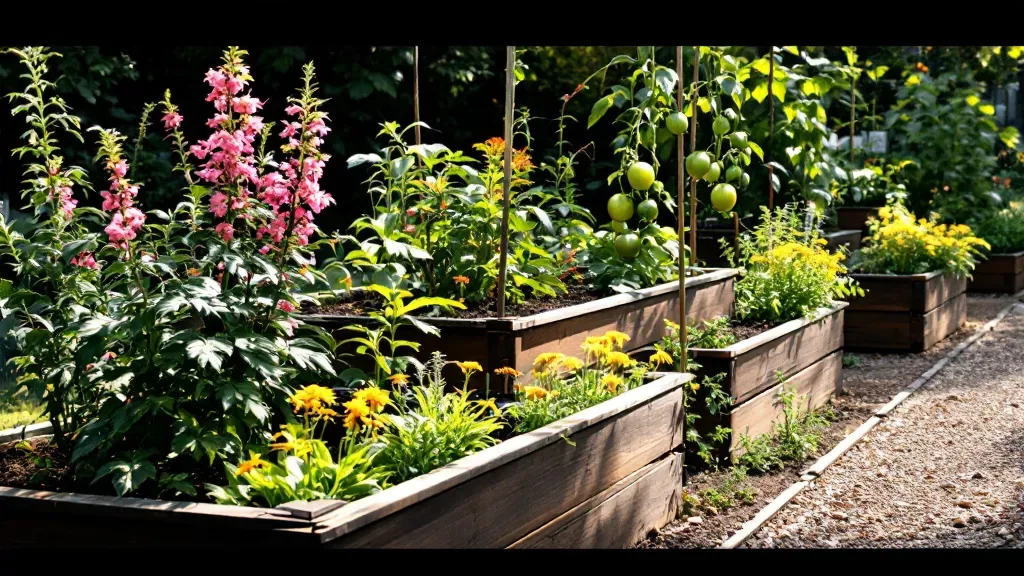
A Maryland master gardener, Kim Leahy, describes a bed in a University of Maryland Extension article. Joe Pye weed grows at the back and tomatoes in the middle. Yarrow, carrots and radishes grow in front, where they help attract pollinators and cover the tomatoes' bare lower stems.
Layers: split a 4 by 8 foot bed into three tiers
Layers are height. Oregon State describes a food forest as vertical stacking of trees and plants that creates microclimates. In a vegetable bed you get the same stacking in three tiers.
Leahy's bed gives you the tiers: tall at the back, the main crop in the middle and low plants in front. This article turns them into a plan. Take a 4 by 8 foot bed. Four feet is 48 inches, and 48 divided by 3 is 16 inches per tier.
| Tier | Plants in Leahy's bed | Depth in our sketch |
|---|---|---|
| Back | Joe Pye weed | 16 inches |
| Middle | Tomatoes | 16 inches |
| Front | Yarrow, carrots, radishes | 16 inches |
Leahy does not give bed sizes, so the 16 inches is our sketch and not her measurement. Check each plant's mature spread before you commit. A big plant may need more than its tier, and then you give it a wider band and shrink the others.
Notice what the sketch does. It follows the guild idea, since each tier does a job, and it follows the zone idea, since the low harvest crops sit nearest the path.
How many plants: count per person first
A zone 2 vegetable bed needs a plant count before it needs a guild. Kansas State's planting guide lists an approximate planting per person for each vegetable. Multiply by the number of people you feed.
| Vegetable | Per person (Kansas State) | For 3 people |
|---|---|---|
| Tomatoes | 3 to 5 plants | 9 to 15 plants |
| Peppers | 3 to 5 plants | 9 to 15 plants |
| English peas | 15 to 20 feet of row | 45 to 60 feet |
| Leaf lettuce | 10 feet of row | 30 feet |
| Parsley | 1 to 3 feet of row | 3 to 9 feet |
Kansas State adds that even a 100-square-foot garden can produce a good portion of the vegetables for a family of four. Count only the food crops this way. The helper plants in a guild come on top of the count.
Mistakes the extension sources warn about
Permaculture mixes solid practice with big claims. Extension writers keep the first and test the second.
Oregon State's slides put dynamic accumulators under the heading fact or fiction. They say phytoaccumulation, a plant taking up minerals, does happen. They add that it is not known whether the plant makes those minerals available to the soil, or how long that would take. Treat that kind of claim as a test bed in one corner, not as the base of your plan.
Starting too big is the second mistake. NC State advises testing new ideas on a small scale and becoming comfortable and knowledgeable before expanding. Leahy says that in most home gardens all you need is small steps, patience and faith in the process.
Designing before you observe is the third. A bed placed where water puddles or the afternoon sun burns it will fail whatever the guild.
Fixing a mistake mid-season follows the same rule. Change one bed, not the yard, and write down what you changed and what happened. A garden journal, the handbook says, helps you see patterns, such as drought stress followed by insect problems.
Sites where design needs a person on the ground
A printed plan fits a bed, a zone map and a notebook. It does not design earthworks, a food forest with canopy trees or a lot with serious drainage problems. For those you need a site visit and a professional.
You may also not need to buy anything. Graph paper and the free extension pages linked above cover zones, guilds and tiers at no cost. A kit adds a dot-grid sun map and a 4 by 8 foot bed already ruled to scale.
The Winter Plan in The Garden Year bundle is for a gardener who wants the yard and sun map and the true-scale bed already printed. It does not teach permaculture. It gives you a place to draw this plan and keep notes through the season.
In winter you draw zones on the yard and sun map and the guild on the 4 by 8 bed plan. In season, the notes-for-next-winter page holds your planting dates and what you saw, and the Companion Planting Plan has a pair planting log and a pair verdicts page for how each pairing worked.
FAQ
How do I plan a permaculture garden?
Watch your yard first, ideally through all four seasons. Then place plants by how often you visit them, with daily herbs nearest the house. Give every plant in a bed a job, such as attracting pollinators or covering bare soil, and start with one small bed before you expand.
What are common permaculture mistakes?
Extension sources warn against designing before you have observed the site, starting too big, and treating unproven ideas as fact. Test new ideas on a small scale and become comfortable before you expand.
Conclusion
Sketch one bed this winter. Put the plants you pick daily in the zone nearest the door, give each plant in the bed a job, and split the depth into tiers. Then watch that bed for a full year before you redraw the rest of the yard.
Sources
- North Carolina State Extension, Extension Gardener Handbook, Appendix G: Permaculture Design (2022), last checked October 5, 2026
- University of Maryland Extension, Permaculture and the Home Garden: Finding a Balance (undated), last checked October 5, 2026
- Kansas State University Research and Extension, Vegetable Garden Planting Guide, MF315 (2023), last checked October 5, 2026
- Oregon State University Extension Service, Permaculture Basics for Master Gardeners (2018), last checked October 5, 2026