Raised Garden Planner: 4x4 and 4x8 Layouts
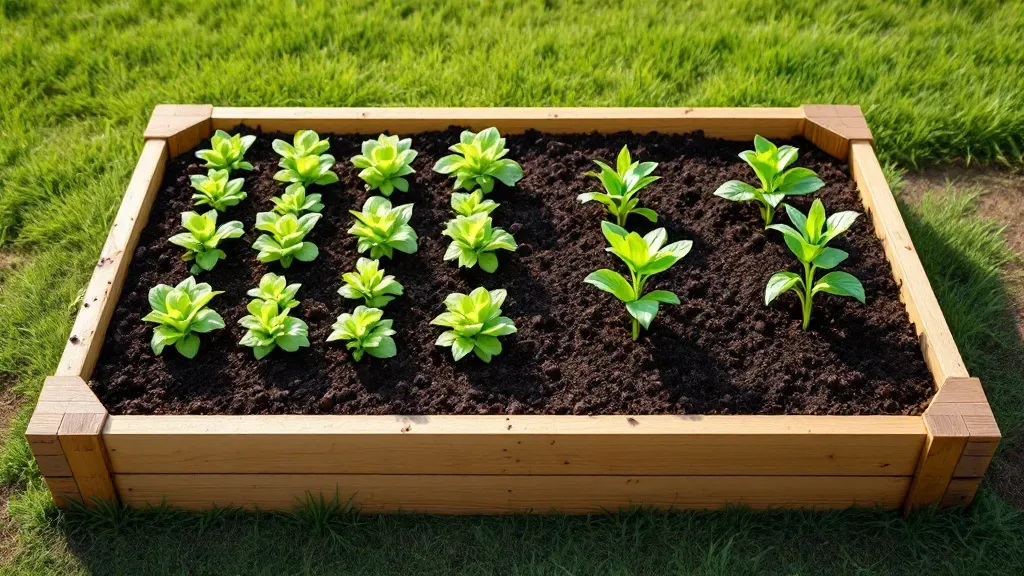
You have a raised bed, or you are about to build one, and you need to know what goes where. A raised garden planner is a scale drawing of each bed with every crop's spot, spacing and plant count written on it.
Published
Step 1: Choose a bed size and place it in the sun
A raised bed has two sizes that matter. Width decides whether you can reach it. Length decides how much it holds.
A Colorado State University Extension fact sheet says a bed four feet wide is ideal for most vegetables, because you can reach the whole bed from the side without stepping on the soil. A Washington State University Extension handout says eight feet is a convenient length. So 4x8 is the common size, and 4x4 is the half-size version for a smaller yard.
The Washington sheet also asks for at least six hours of sun a day and suggests running the bed north to south, so short plants get less shade. Colorado State sees no clear advantage either way and says to orient beds however suits your yard. Pick the spot that gets the sun.
Leave paths. Washington says a path of 1.5 to 2 feet is comfortable for most people, and wider if you push a wheelbarrow.
Step 2: Fill the bed with one soil, 8 to 12 inches deep
Depth matters less than people think. Where the ground below is poor, the Colorado sheet calls 8 to 12 inches of soil the minimum, and deeper beds are easier to manage. Where the ground below is fine, a bed only 4 inches high is enough to mark off the planting area.
The fill volume is simple multiplication. Length times width times depth in feet gives cubic feet.
| Bed | At 8 inches deep | At 12 inches deep |
|---|---|---|
| 4x4 | 10.7 cubic feet | 16 cubic feet |
| 4x8 | 21.3 cubic feet | 32 cubic feet |
Divide those numbers by the cubic feet printed on the bag, or order by the cubic yard, which is 27 cubic feet.
The mix is where beds go wrong. Use soil similar to the ground below, and blend the two if they differ. The Colorado sheet warns that a sharp line between soil types blocks water, air and roots. It also says there is no legal definition of topsoil or planting soil, and that some bagged soils are made with manure compost and can be high in salts. For the frame, it says copper-treated lumber is safe, and railroad ties and CCA pressure-treated lumber, which was made with arsenic, are not.
Plan the water with the soil. Raised beds need more frequent irrigation than rows because the plants are packed closer, says Colorado State, yet they give more yield per gallon than row-and-walkway gardens. The sheet calls drip irrigation well suited to raised beds, with the hose run up and down the bed four times at 12 inch spacing, and says to mulch the bed to conserve soil moisture and control weeds.
Step 3: Space the crops in blocks and count the plants
In a raised bed you plant in blocks, not rows. Space plants an equal distance apart in both directions. The Colorado sheet says this block layout raises yields fivefold compared with a row garden, because it drops the walkways between rows.
The same sheet lists spacings, and says to start with the wider numbers. The table uses the wide end of each range. Plants across times plants along, rounded down. Peppers and cabbage-family plants use the sheet's own "three across a four foot bed."
| Crop | Spacing | In a 4x4 bed | In a 4x8 bed |
|---|---|---|---|
| Carrots or radishes | 3 inches | 256 | 512 |
| Beets or spinach | 6 inches | 64 | 128 |
| Leaf lettuce or Swiss chard | 9 inches | 25 | 50 |
| Peppers | 15 inches | 9 | 18 |
| Broccoli, cabbage or cauliflower | 18 inches | 6 | 15 |
Read the pepper row twice. A 4x8 bed of peppers is 18 plants. A Kansas State University guide puts a household's planting at 3 to 5 pepper plants per person, so one bed of peppers can feed a crowd.
Count for your household the same way. Kansas State lists 3 to 5 plants per person for tomatoes and peppers, so a family of four wants 12 to 20 of each. The two tomatoes in the 4x8 layout below are fewer than one person's share, so spread tomatoes over several beds or accept a smaller harvest.
A raised bed rewards the gardener who counts plants before shopping.
Step 4: Lay out one 4x4 and one 4x8 bed
Spacing tables give you counts. A layout gives you a plan. These two use only the sourced spacings above.
A 4x4 bed, two strips. Give a 2x4 foot strip to bush beans. Beans are easier to pick in single or double rows, so the Colorado sheet gives them 12 inches between rows and 4 inches between plants. Two rows of 12 plants along 4 feet is 24 beans. Give the other 2x4 strip to carrots at 3 inches, which is 8 across and 16 along, or 128 carrots.
A 4x8 bed, three sections. The first 4 feet hold two trellised tomatoes. The same sheet wants trellised tomatoes at least 24 inches apart in a single row. The next 2.5 feet hold two rows of peppers, 15 inches apart, three plants across each: 6 peppers. The last 1.5 feet hold leaf lettuce at 9 inches, 5 across and 2 along: 10 plants. The sections add up to 8 feet.
Step 5: Keep out the crops that do not fit, then write down the dates
Some crops are poor tenants of a small bed. The Kansas State guide lists winter squash at 48 to 60 inches between plants and pumpkins at 48 to 60 inches as well, so one plant takes the full width of a 4 foot bed. Colorado State says corn needs a block at least three rows wide, and five is better for pollination. A single 4 foot bed holds only two rows of corn at its 24 inch row spacing, so corn belongs in two beds or none.
Decide which crop goes in which bed by how it is planted. In the Colorado sheet, carrots, beets, lettuce, peppers and cabbage-family plants fill blocks across the full width. Trellised tomatoes and beans each get a strip two to three feet wide, which is why Step 4 gives them their own sections. Vine crops take a single row down the middle, with winter squash and pumpkins in the center and summer squash at the edge where you can reach them.
Fixes in midseason follow from the same sheet. Crowded plants cut air flow, and the sheet says poor circulation can raise disease problems, so give the next planting the wider spacing. When a crop of radishes, beets, lettuce or spinach is harvested, the sheet says to replant that space, so write the new date beside the old one.
Then add dates. A University of Wisconsin-Madison Extension article suggests drawing your garden map to scale on graph paper to be sure everything fits. Draw each bed at 1 inch to 1 foot, and a 4x8 bed becomes a 4 by 8 inch rectangle, which fits on a Letter sheet. Write each crop's sowing and transplant dates beside its section.
The Winter Plan has true-scale bed plans for those drawings. They sit beside a crop chart and dated sowing pages counted from your own last-frost date.
| Step | What to do | What to check |
|---|---|---|
| 1 | Pick 4 feet wide by 4 or 8 feet long, in six or more hours of sun | Can you reach the middle from both sides? |
| 2 | Fill 8 to 12 inches deep with one soil | 16 or 32 cubic feet for a 4x4 or 4x8 at 12 inches |
| 3 | Space crops in blocks and count plants | 18 peppers fill a 4x8 bed |
| 4 | Draw the sections and add up their lengths | Sections must total the bed length |
| 5 | Leave out sprawlers and add dates | Pumpkins, winter squash and corn need more room |
One raised bed or one pot needs no raised garden planner
A printed planner is the wrong pick if you want to drag beds around on a screen, or if you only have one container. A single pot needs the spacing on its seed packet, not a drawing.
You may also not need to pay at all. Free extension pages publish bed spacings, free printables exist, and graph paper costs almost nothing. The 4x4 and 4x8 plans above need only a pencil and a ruler. The kit adds the same plans already drawn to scale for several bed sizes.
In the file, you fill in the bed plans early in the year and then use the succession waves page for resowing, the spring week list for the jobs, and the notes-for-next-winter page for what to change next year.
FAQ
What is the best layout for a raised bed garden?
Make the bed 4 feet wide so you can reach the middle from either side, make it as long as suits your yard, and plant in blocks with equal spacing in both directions instead of single rows. Eight feet is a convenient length, and a 1.5 to 2 foot path on each side keeps you off the soil.
How many pepper plants can I put in a 4x8 raised bed?
At the 15 by 15 inch spacing in one Colorado State fact sheet, a 4x8 bed holds 18 pepper plants, three across and six along. That fills the whole bed, so most gardeners plant fewer and give the rest of the bed to other crops.
How much can you plant in a 4x4 raised garden?
It depends on the crop. At the wider spacings in the Colorado State sheet, a 4x4 bed holds about 9 peppers, 6 cabbage-family plants, 25 leaf lettuce or chard plants, 64 beets or spinach plants, or 256 carrots or radishes.
What should I put in the bottom of my raised garden beds?
Soil that is similar to the soil underneath. Colorado State says an abrupt line where one soil type ends and another begins slows water, air and root growth, so if the bed soil differs from the ground, mix some of both before you add the rest.
How many bags of soil to fill a 4x4 raised bed?
A 4x4 bed filled 12 inches deep needs 16 cubic feet of soil, and 10.7 cubic feet at 8 inches deep. Divide that by the cubic feet printed on the bag you plan to buy.
Conclusion
Build the bed 4 feet wide, fill it 12 inches deep with soil that matches what lies below, and space crops in blocks instead of rows. Count plants before you buy: 18 peppers fill a whole 4x8 bed, so three or four is usually plenty. Draw each bed at 1 inch to 1 foot, then write sowing dates beside the crops.
Sources
- Colorado State University Extension, Block Style Layout in Raised Bed Vegetable Gardens, GardenNotes 713 (2023), last checked October 5, 2026
- Washington State University Extension (Pierce County Master Gardeners), Raised Bed Gardening, RS 009 (2010), last checked October 5, 2026
- University of Wisconsin-Madison Extension, Beginning Vegetable Garden Basics: Site Selection and Soil Preparation (2021), last checked October 5, 2026
- Kansas State University Research and Extension, Vegetable Garden Planting Guide, MF315 (2023), last checked October 5, 2026