Rhubarb Planting Guide: Crowns, Timing, Year Three
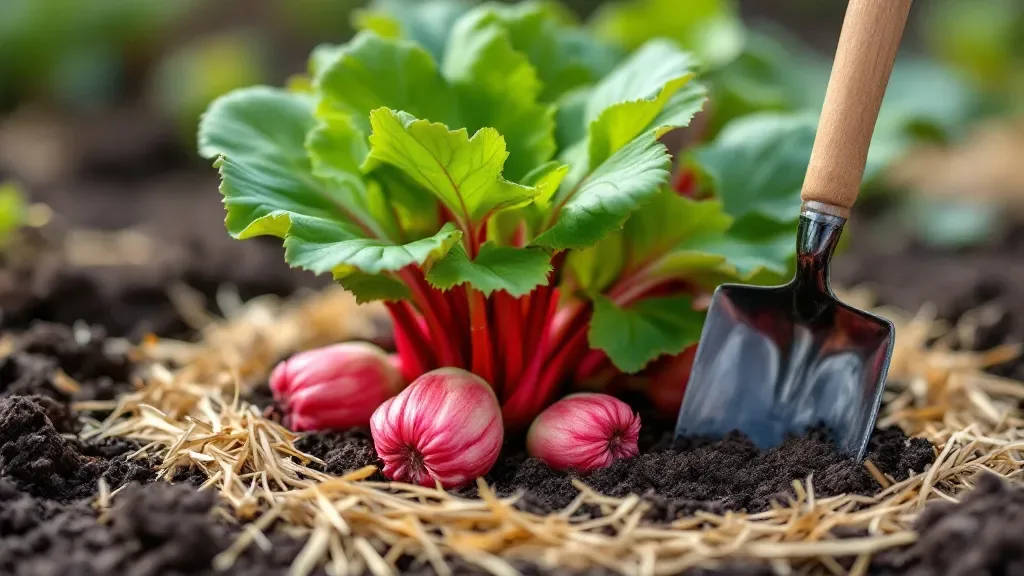
You have a rhubarb crown in a bag, or a neighbour has offered you a division. A rhubarb planting guide starts with the calendar: set the crown in the ground as soon as the soil can be worked in spring, then leave the stalks alone for two full years.
Published
The rhubarb planting guide in five steps
Rhubarb is a perennial. You plant a crown once and it comes back every spring. The table shows the five steps, and each one is explained below.
| Step | What you do | What to watch for |
|---|---|---|
| 1 | Buy crowns with at least 2 large buds | Seedlings from seed do not match the parent plant |
| 2 | Pick a sunny, well-drained spot | Each plant needs 12 to 15 square feet |
| 3 | Plant in early spring, bud up | Cover the crown with only 1 to 2 inches of soil |
| 4 | Pick nothing for two years | First picking is the third spring, about 4 weeks |
| 5 | Mulch after the first light freeze | Keep mulch off the crown itself |
Step 1: Buy crowns, not seed
Buy a crown, which is a chunk of root with buds on top. A Purdue Extension publication by B. Rosie Lerner and Michael N. Dana says rhubarb can be grown from seed, but the seedlings do not match the mother plant and are generally of inferior quality. It recommends crowns of a known variety.
Look for crowns with at least 2 large buds. A 2011 Utah State University Extension fact sheet asks for a large leaf bud on top and undamaged roots underneath. Garden centers sell crowns in late winter or early spring. Potted plants appear in late spring and early summer.
Keep the crown moist until it goes in the ground. Purdue cautions that a crown that dries out before planting can be damaged.
Purdue recommends the red-fleshed varieties Valentine, Canada Red, McDonald and Ruby, and the green-stalked Victoria. Valentine tends to produce fewer seed stalks than the others. Seed stalks drain the plant, so a variety that makes fewer of them saves you a chore.
Rhubarb rewards the gardener who plants it once and waits.
Step 2: Choose a sunny spot with 12 square feet to itself
Rhubarb needs full sun. Put it where the plants can receive full sun, Purdue advises, along the side of the garden with other perennial crops, out of the way of the digging you do every spring. The same page says two to three plants are usually enough for an average family.
Drainage matters as much as light. A fertile, well-drained sandy loam is best, says Purdue, and good drainage lowers the chance of crown rot. Before planting, Utah State says to clear all perennial weeds and work 2 to 4 inches of well-composted organic matter 6 inches deep into the soil.
Plan for the full-grown plant. Mature rhubarb grows over 3 feet tall and wide, according to Utah State. Purdue's spacing is 3 feet apart in rows 5 to 6 feet apart, which gives each plant 12 to 15 square feet. Utah State puts the rows 4 feet apart, and 3 feet by 4 feet is 12 square feet, the low end of Purdue's range.
Here is the sum for a raised bed. A 4 by 8 foot bed is 32 square feet. At 12 to 15 square feet per plant, it holds two rhubarb crowns. A strip along a fence often suits rhubarb better than a bed you also want for lettuce.
Rhubarb stays put for a decade or more, so the spot is a long decision. A yard and sun map with bed plans at true scale lets you draw the 3-foot circle on paper before you dig.
Step 3: Plant the crown in early spring
Plant as soon as you can work the soil. Rhubarb is very hardy, and Purdue says it can go in as soon as the ground can be easily worked. Utah State gives late March to mid-April for northern Utah, so count from your own thaw, not from a date on a page.
Set the crown bud side up. Cover crowns with no more than 1 inch of soil, firm the soil around them and water well, advises Utah State. In Purdue's version, shallow furrows leave the crowns 2 inches below the surface. The two sources differ by an inch, so aim for the shallow end. Planting too deep delays maturity and can kill the plant, the Utah fact sheet warns.
Water the young plant on a schedule. For the first 2 to 3 years, water once or twice a week so the water reaches the bottom of the root ball, and mulch with straw, grass clippings or bark. It also says not to fertilize in the first year.
Step 4: Wait two years, then pick the stalks only
Do not pick in the first two seasons. Let all leaves grow for 2 years after planting, so the plant builds good crowns and roots, advises Purdue. The Utah fact sheet agrees: no stalks for the first 2 years.
The leaves are doing a job. A young plant makes food in its leaves and stores it in the root. Picking before the third season reduces stalk size and overall yield, according to Purdue. So the three years people talk about are two years of waiting and a first picking in the third spring.
The pick window grows with the plant. The timeline shows the Purdue numbers.
| Season | Picking | Source |
|---|---|---|
| Springs 1 and 2 | None | Purdue, Utah State |
| Spring 3 | About 4 weeks | Purdue (Utah State: 3 to 4 weeks) |
| Spring 4 and later | 8 to 10 weeks | Purdue (Utah State: 6 to 10 weeks) |
Add it up. Over your first five springs, the Purdue numbers give 0 + 0 + 4 + 8 to 10 + 8 to 10, which is 20 to 24 weeks of picking. Sixteen to twenty of those weeks come in springs four and five.
When you do pick, take stalks 10 to 15 inches long. Grasp the stalk near its base and pull it slightly to one side. Do not take more than two-thirds of the stalks from a plant at one time. Never cut stalks at the base, because the cut can let disease in.
Throw the leaves away. The leaf blades contain oxalic acid and are not edible, raw or cooked, per Purdue. The Utah fact sheet adds that the leaves can make you quite sick and lead to kidney failure. It says to discard them in the compost pile or leave them in the garden as mulch.
Cut off any flower stalk as soon as it begins to grow. Flowering reduces vigor and stalk production, per Utah State.
Step 5: Winterize rhubarb with mulch after the first freeze
Wait for the first light freeze in fall. Purdue advises mulching with 3 to 4 inches of strawy manure around the plants, but not on the crowns. Add more mulch the next spring before the weather turns hot and dry.
A plant that is divided in late fall needs more care. Straw or a similar winter mulch should protect it after several hard frosts. Divide established plants every 5 to 10 years, in early spring before new growth starts, and replant the pieces 3 feet apart, suggests Utah State.
To divide, follow Iowa State Extension. Dig up the plant just as the leaves begin to emerge, and dig deeply so you keep a large part of the root system. Cut down through the crown between the buds. Each division should hold at least two or three buds and a large piece of root. Replant soon, because the roots must not dry out, and set each piece at the depth it grew before.
A rhubarb plant can live in the garden for 10 to 15 years, says Utah State. A healthy plant yields 4 to 12 pounds of stalks a year, depending on age, variety and growing conditions.
When rhubarb is your only crop
If rhubarb is the only thing you are planning, you do not need to buy anything. The extension pages linked above cover everything in this guide, and free printables exist too. A planting kit starts to help when rhubarb is one of many crops, and you want its spot, its planting year and your annual vegetable beds on the same sheet. The Winter Plan has a rotation planner for annual crops. Rhubarb stays in one place, so you draw it as a fixed square on the whole-plot graph and bed plans and plan the beds around it.
FAQ
Does rhubarb need full sun?
Yes. Purdue Extension says to set rhubarb where the plants can receive full sun. Pick a spot with good drainage too, because wet soil can cause crown rot.
Can you eat rhubarb leaves?
No. Purdue Extension says the leaf blades contain oxalic acid and are not edible, raw or cooked. Utah State Extension says the leaves can make you quite sick. Eat the stalks only, and trim the leaves off at harvest.
How to winterize rhubarb in the fall?
After the first light freeze, spread 3 to 4 inches of strawy manure around the plants, but keep it off the crowns, as Purdue Extension advises. Add more mulch the next spring before hot, dry weather.
Why do you have to wait 3 years to harvest rhubarb?
You wait two years and pick in the third season. The leaves of a young plant make food that is stored in the roots, and Purdue Extension says picking before the third season shrinks stalk size and overall yield.
Conclusion
Set one or two crowns in a sunny spot this spring, 3 feet apart and about an inch or two under the soil. Write the planting year on your garden map, and pick nothing until the third spring. After that, the same plant feeds you for 10 to 15 years.
Sources
- Purdue University Extension, HO-97: Rhubarb (undated), last checked October 5, 2026
- Iowa State University Extension and Outreach, Growing Rhubarb in Iowa (2025), last checked October 5, 2026
- Utah State University Extension, How to Grow Rhubarb in Your Garden (2011), last checked October 5, 2026