Seed Inventory Printable: What to Track
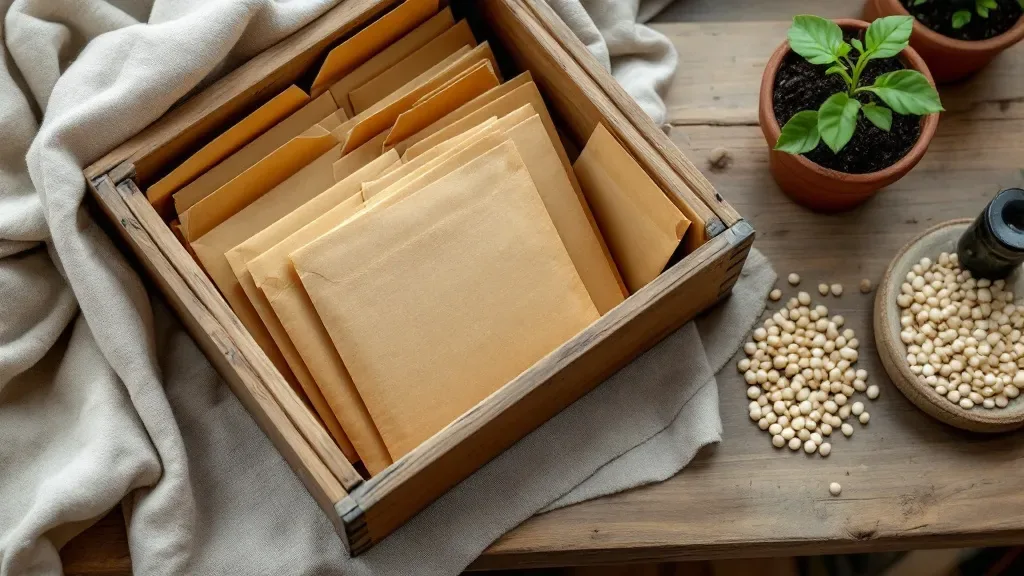
You have a drawer of half-used packets and no idea what is in it. A seed inventory printable is a one-page list of every packet you own, with the year, the amount left and a germination result, so you can check it before you order.
Published
What a seed inventory printable tracks
A seed inventory printable is a table with one row per packet. Each row answers one question. Do I own this seed, how old is it, and can I still count on it?
Six columns are enough. A longer table is one you stop filling in. An Iowa State extension page on garden journaling lists a seed inventory among the things worth recording, next to seed starting dates and harvest dates. The same page names plant sources and favorite varieties as worth writing down, which is what the first two columns hold.
| Column | What you write | Why it earns its place |
|---|---|---|
| Crop and variety | Pepper, the exact name on the packet | Two tomato packets are not the same tomato |
| Where from | Brand or the friend who gave it to you | You know where to reorder a variety you liked |
| Year | The year on the packet, or the year you bought it | Seed life is counted in years |
| Amount left | Full, half or a pinch | Tells you if one sowing is all you have |
| Test result | Seeds sprouted out of ten, and the date | A packet with no test is a guess |
| Plan | The bed or tray it is meant for | Keeps leftovers from being forgotten |
A seed list you can read in one minute gets used. A seed list you have to decode gets skipped.
Where the packets live so you can find them
The list only works if the packets sit in the same order as the rows. Keep them in one box, sorted by crop, and number nothing you do not need to. A row for tomato should lead you to the tomato envelope in one move.
A South Dakota State page on storing leftover seed says seeds keep in sealed containers, plastic bags, and wax or paper envelopes. It adds that a refrigerator can extend storage life by several years if the seed sits in a sealed container. Let the container reach room temperature before you open it, so no condensation forms on the seed.
Seed you saved yourself needs the same row, with two changes. Write the plant it came from in the Where from column and the harvest year in the Year column. The South Dakota page says to dry saved seed thoroughly before you store it.
Seed life: how old is too old for each crop
Seeds do not spoil on a date. They lose their ability to sprout a little each year, and some crops lose it faster than others.
A Colorado State University Extension fact sheet on storing vegetable and flower seeds gives a table of relative longevity. It lists onion and parsley at 1 year, sweet corn and pepper at 2, bean at 3 and tomato at 4. A South Dakota State University Extension page on leftover garden seeds gives a different table. It puts corn, lettuce, onion and pepper at 2 years, bean at 3 and tomato at 4.
| Crop | Colorado State (years) | South Dakota State (years) |
|---|---|---|
| Onion | 1 | 2 |
| Lettuce | 1 | 2 |
| Corn | 2 | 2 |
| Pepper | 2 | 2 |
| Bean | 3 | 3 |
| Tomato | 4 | 4 |
The two tables agree on corn, pepper, bean and tomato and differ by a year on onion and lettuce. Treat a seed life as a rough guide, then test the packet. The same South Dakota page says most seed lasts more than a year past the sell-by date on the packet.
Storage changes the numbers. The Colorado State sheet says seed keeps longest dry, below 8 percent moisture, and cold, below 40 degrees. The South Dakota page says to keep seed away from direct sun and warns that temperatures above 90 degrees greatly lower viability. Keep the packets indoors on a cool, dry shelf, not in a hot shed.
Test the doubtful packets before you count on them
A packet that is past its seed life is not trash. It is a packet that needs a test.
An Illinois Extension post on testing seed viability gives the method. Put 10 seeds on a slightly damp paper towel and check after 7 to 10 days if you do not know the crop's germination time. Seventy to 90 percent germination means you should sow a little thicker than normal. Under 70 percent, the post says, it might be better to buy new seed.
Ten seeds make the sum easy. Every sprouted seed is 10 percent, so 7 sprouted seeds is 70 percent. Write that number in the Test result column with the date.
The test result also tells you how many seeds to sow. Say you want 12 pepper plants and 7 of your 10 test seeds sprouted. Divide 12 by 0.7 and you get 17.1, so sow 18 seeds. That is the number to put in the Plan column, not 12.
Count your needs against the list before you order
The list pays off in winter, before the catalogs arrive. Work through it in four moves.
Start with the crops you plan to grow. Write each one on a scrap of paper with how many plants you want. Then find the matching row in your inventory.
Update the list at three moments. Add a row when seed arrives, write the test result the day you count the sprouts, and change Amount left after each sowing. Then the winter pass is a read, not a rewrite.
A recent year and enough seed means you need nothing. An old year or a thin packet goes to the paper towel test. An empty row, or a failed test, goes on the order list. Everything else stays in the drawer.
A printed page works well here because you can lay it beside the packets and mark it with a pencil. The Seed-Starting Countdown has a seed inventory page placed next to a germination test with sow arithmetic, so the list and the test sit in the same file.
A worked example: a three-year-old stack of packets
Take six packets bought in 2024 and planted in 2027. Each one is 3 years old. Compare that age with the two tables above.
| Packet | Age | Inside its seed life? | What to do |
|---|---|---|---|
| Tomato | 3 | Yes, both tables say 4 | Plant, test if you are unsure |
| Bean | 3 | At the limit, both say 3 | Test before sowing |
| Pepper | 3 | No, both say 2 | Test, expect to buy new |
| Corn | 3 | No, both say 2 | Test, expect to buy new |
| Onion | 3 | No, 1 or 2 | Test, expect to buy new |
| Lettuce | 3 | No, 1 or 2 | Test, expect to buy new |
Only 1 of the 6 packets, the tomato, is still inside its seed life in both tables. The bean sits at the edge. Four need a test and probably a reorder. That is the case for writing the year down, because the same drawer feels full and is mostly past its best.
When a seed list is more than you need
If you keep hundreds of varieties, save seed from your own plants in bulk or run a seed swap, a spreadsheet you can sort by crop and year will serve you better. If you buy fresh seed every spring and never keep leftovers, a shopping list is enough. If a free extension chart or a notebook already holds your seed list and you keep it up, you do not need The Seed-Starting Countdown.
For everyone else, the free tables above answer the lookup, and the kit adds the sow sum and the dates in one file. Its dates count from your own last-frost date, and a table of last and first freeze dates (10, 50 and 90 percent) for 108 NOAA stations, from the 1991 to 2020 normals, helps you pick one in any US zone. You fill the inventory page in winter, the test page before sowing, and the weekly log pages from 14 weeks before frost.
FAQ
Conclusion
Fill the list in once, in one sitting, with every packet on the table. Mark the old ones for a paper towel test, count what you need for next season, and order only the gap. Next winter you will start from a list that is already half done.
Sources
- Colorado State University Extension, Storing Vegetable and Flower Seeds (2025), last checked October 5, 2026
- Illinois Extension, Test Seed Viability (2017), last checked October 5, 2026
- South Dakota State University Extension, How to Store Leftover Garden Seeds (2024), last checked October 5, 2026
- Iowa State University Extension and Outreach, Garden Journaling (2025), last checked October 5, 2026