Seed Starting Chart: Start Dates by Crop
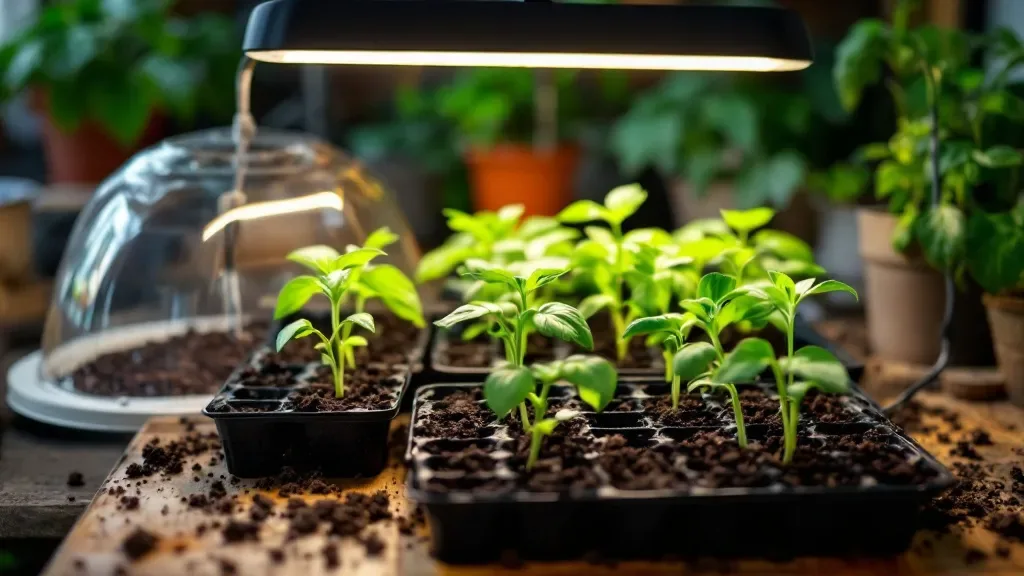
You have packets of seed and a last frost date, and you want to know which tray to sow first. A seed starting chart gives each crop a start date counted back from your last frost, and you can build one by adding the weeks a seedling spends indoors to the week it goes outside.
Published
How to read a seed starting chart
Every seed starting chart is two numbers hiding in one row. The first is how many weeks a seedling spends indoors. The second is the date it goes outside, counted from your last spring frost. Add them and you have the date to sow.
The first number comes from the University of Maryland Extension guide to starting vegetable seeds indoors. It lists the time to grow transplants indoors as 2 to 4 weeks for leafy greens, 4 to 6 weeks for cabbage, broccoli and cauliflower, 3 to 5 weeks for cucumber, squash and melon, 5 to 6 weeks for tomato, and 8 to 10 weeks for pepper, eggplant and onion.
The second number comes from Purdue's Indiana planting calendar. Hardy crops such as broccoli and cabbage go out 4 to 6 weeks before the average last spring frost. Semi-hardy lettuce goes out 2 to 4 weeks before it. Tomato goes out after it. Pepper, eggplant, cucumber, squash and melon go out at least 2 weeks after it.
Take a made-up last frost of April 25 and tomato as the example. Tomato spends 5 to 6 weeks indoors and goes out at the frost date (Purdue says after it, so the sums count week 0), so you sow it 5 to 6 weeks before April 25, between March 14 and March 21.
The chart: start dates counted back from your last frost
Here is the chart for five crop groups. The last column uses the same April 25 last frost, so you can check the sums.
| Crop | Weeks indoors | Set out | Start sowing | If last frost is April 25 |
|---|---|---|---|---|
| Broccoli, cabbage | 4 to 6 | 4 to 6 weeks before frost | 8 to 12 weeks before | Jan 31 to Feb 28 |
| Lettuce | 2 to 4 | 2 to 4 weeks before frost | 4 to 8 weeks before | Feb 28 to Mar 28 |
| Pepper, eggplant | 8 to 10 | 2 weeks after frost | 6 to 8 weeks before | Feb 28 to Mar 14 |
| Tomato | 5 to 6 | After the last frost (week 0) | 5 to 6 weeks before | Mar 14 to Mar 21 |
| Cucumber, squash, melon | 3 to 5 | 2 weeks after frost | 1 to 3 weeks before | Apr 4 to Apr 18 |
Read the "start sowing" column as a range. The early end pairs the longest time indoors with the earliest set-out date. The late end pairs the shortest time with the latest date. With a single sowing, aim for the middle of the range.
The set-out dates are Purdue's Indiana window, so move the whole row if you plan to set plants out later. A tomato set out a week after your last frost starts 4 to 5 weeks before it, not 5 to 6.
Iowa State gives a similar count for its own state. Its crop-time list runs 6 to 8 weeks for pepper and eggplant, 5 to 7 weeks for tomato, cabbage, broccoli and cauliflower, and 3 to 4 weeks for cucumber, watermelon, muskmelon and squash. Treat the weeks as a guide and keep notes on what worked in your yard.
A seed starting schedule is only as good as the frost date you count from.
Why pepper starts before tomato: days to sprout and soil heat
Slow seed sets the order. Kansas State's planting guide lists how long each seed takes to come up and the best temperature for it, and its figures in brackets are for starting indoors.
| Crop | Days to sprout | Best temperature (F) | Planting depth (in.) |
|---|---|---|---|
| Broccoli | 6 to 8 | 50 to 60 | 1/2 |
| Lettuce | 6 to 8 | 50 to 70 | 1/4 |
| Tomato | 7 to 10 | 75 to 85 | 1/2 |
| Eggplant | 8 to 12 | 75 to 85 | Not listed |
| Pepper | 10 to 14 | 75 to 85 | 1/2 |
| Cucumber | 5 to 8 | 75 to 85 | 1/2 to 1 |
Pepper takes up to 14 days to sprout and needs a warm mix, which is part of why it gets 8 to 10 weeks. The University of Maryland says a good mix temperature for most vegetable seeds is 65 to 75 degrees F, and that a seedling heat mat speeds germination. Once the seedlings are up, the same guide says to cool them to 55 to 60 degrees F at night and 65 to 70 degrees F by day.
Broccoli and lettuce list cooler best temperatures in the Kansas State table, 50 to 60 and 50 to 70 degrees F, so they are the trays to keep away from the heat.
Depth, light and which seeds skip the tray
Depth is in the last column above. Maryland's guide gives a rule for crops the table does not list: a suitable planting depth is typically about twice the seed's diameter, so a seed 1/8 inch wide goes 1/4 inch deep. Lettuce seed, the same guide notes, can be left on the surface, uncovered or very lightly covered.
Light is a smaller question than it sounds. A Penn State Extension page on seed biology says most seeds germinate best in the dark and may even be held back by light, and names the onion family as an example. Iowa State adds that some species need light to germinate, so those seeds get only about 1/8 inch of soil. Check the packet for lettuce and other tiny seed.
Some crops are better sown where they will grow. Iowa State's direct seeding page says the method suits crops that are not easy to transplant, like carrots and beets. Kansas State lists bush and pole beans, peas, sweet corn, radish, spinach and turnip as seeded crops, with no transplant option. The same page lists cucumber, squash and melon as crops that can be started indoors or direct-seeded in the garden.
Set up the tray so the dates hold
A chart tells you when. The tray decides whether the plants are worth planting.
Light is the usual weak spot. The University of Maryland says natural window light is seldom enough for strong seedlings, and that stems stretch and lean toward it. Keep LED or fluorescent lights 2 to 6 inches above the plants and lit 14 to 16 hours a day.
Water to keep the mix moist but not wet. Wait until the top is nearly dry before the next watering. Too much water starves the roots of oxygen, and the Maryland sheet blames water molds for damping-off, which can wipe out a tray quickly.
Almost any clean container works. Maryland says it needs drainage holes and a depth of at least 2 inches, and the guide suggests 3 to 6 square inches of cell for greens, 4 to 9 for broccoli and squash, and 9 to 16 for tomato, eggplant and pepper.
Do not sow too early. Maryland calls it a common mistake and says it gives tall, root-bound plants that do not perform well in the garden. A good tomato transplant is stocky, 8 to 10 inches tall after 5 to 6 weeks, and about as wide as it is high.
Pot up seedlings when the first true leaves appear if they share a flat. Maryland says leaving seedlings in the seed flat too long is one of the most common mistakes.
Fit the chart to your own yard
Your last frost date sets every row, so get it right. Use the average last frost for the weather station nearest you, then move your dates later if your yard runs cold and earlier if it is sheltered. Your own notes from past years beat any table.
Moving the date moves every row by the same number of weeks. That is why one chart works in any US zone, as long as you count from your own frost date and not from a printed month.
If you grow only tomatoes, peppers and a few brassicas, and your state extension office publishes a seed-starting calendar for your county, use that calendar. A local sheet fits your climate better than a general count, and it is free.
The Seed-Starting Countdown is for the grower who wants the whole indoor season in one file. It does not look up your frost date, but it holds a table of last and first freeze dates (10, 50 and 90 percent) for 108 NOAA stations, from the 1991 to 2020 normals, to help you pick one. The countdown page shows what to sow this week, one log page for each week from 14 weeks before frost takes the sowing date, and the transplant day log takes what happens later. To sow by hand from the table above, you do not need any of it.
FAQ
What month should I start my seeds indoors?
It depends on your last frost date. Take the weeks for the crop and count back from that date. With a last frost on April 25, tomatoes start in mid-March and peppers start between late February and mid-March.
How old are seedlings when they are planted?
It depends on the crop. The University of Maryland lists 2 to 4 weeks for leafy greens, 4 to 6 weeks for cabbage and broccoli, 5 to 6 weeks for tomato and 8 to 10 weeks for pepper and eggplant.
What is the ideal light schedule for seedlings?
The University of Maryland says to keep LED or fluorescent lights 2 to 6 inches above the plants and lit for 14 to 16 hours a day on an outlet timer.
Should seeds be watered every day?
Not on a fixed schedule. The University of Maryland says to keep the mix moist but not wet and to wait until the top is nearly dry before you water again.
What do most seeds need in order to germinate?
A warm, moist growing mix. The University of Maryland gives 65 to 75 degrees F as a good mix temperature for most vegetable seeds, and says a dry spell after germination starts can kill the embryo.
Can seeds germinate in 2 days?
Not the vegetables in Kansas State's planting guide. Its fastest, spring radish, lists 4 to 6 days, tomato lists 7 to 10 days and pepper lists 10 to 14.
How big should I let seedlings get before planting?
For tomato, the University of Maryland describes a stocky plant 8 to 10 inches tall after 5 to 6 weeks, about as wide as it is high. Tall, floppy plants are a sign you sowed too early.
What are common mistakes when starting seeds indoors?
The University of Maryland names sowing too early, which gives tall, root-bound plants, leaving seedlings in the seed flat too long, and uneven or heavy watering that can cause damping-off.
Conclusion
Pick your last frost date, then count back from it crop by crop. Sow peppers first, tomatoes next, and cucumbers last, and move every date later by the same number of weeks if you plan to set plants out late. Check each tray for stretching, and pot up or plant out before the seedlings outgrow their cells.
Sources
- University of Maryland Extension, Starting Vegetable Seeds Indoors (2026), last checked October 5, 2026
- Purdue University Department of Horticulture and Landscape Architecture, Indiana Vegetable Planting Calendar, HO-186-W (2020), last checked October 5, 2026
- Kansas State University Research and Extension, Vegetable Garden Planting Guide, MF315 (2023), last checked October 5, 2026
- Iowa State University Extension and Outreach, When should I sow my flower and vegetable seeds indoors? (2021), last checked October 5, 2026
- Penn State Extension, Seed and Seedling Biology (2025), last checked October 5, 2026
- Iowa State University Extension and Outreach, Direct Seeding Vegetables and Annuals: Preparation and Care (2025), last checked October 5, 2026