Seed Viability Chart: How Long Seeds Last
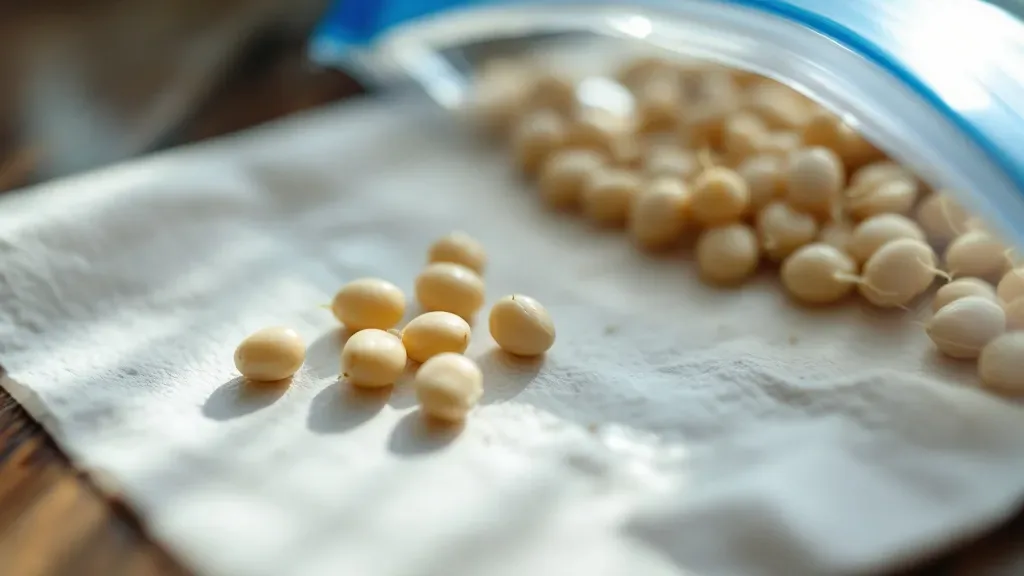
You found a drawer of old seed packets and need to know which ones to sow. A seed viability chart lists how many years each vegetable seed stays good, from 1 year for onion and parsley to 5 or 6 for lettuce, cucumber and radish, and a paper towel test checks the packet in your hand.
Published
Seed viability chart: years by crop
Two university tables agree on most vegetables. The first is a University of Nebraska-Lincoln Extension guide to seed storage and germination, which calls its numbers relative longevity. The second is a University of Illinois Extension seed viability sheet, which calls them approximate seed life.
The two tables share 34 crops. On 31 of them they give the same number of years, and the table below groups those 31 by years.
| Years | Crops where both tables agree |
|---|---|
| 1 | Onion, parsley, parsnip |
| 2 | Sweet corn, okra, pepper |
| 3 | Asparagus, bean, broccoli, carrot, celery, Chinese cabbage, kohlrabi, pea, spinach |
| 4 | Beet, Brussels sprouts, cabbage, cauliflower, Swiss chard, eggplant, kale, pumpkin, rutabaga, squash, turnip, watermelon |
| 5 | Cucumber, endive, muskmelon, radish |
Read the number as a planning guide. A packet inside its years should sprout well. A packet at or past them needs a test before you count on it.
Seed loses vigor long before it loses the ability to sprout.
Where the tables disagree
Leek, lettuce and tomato get different numbers from different universities. A third source, a University of Wisconsin-Madison Extension page on testing seed viability, adds a split on spinach.
| Crop | Nebraska | Illinois | Wisconsin |
|---|---|---|---|
| Leek | 6 years | 2 years | Not listed |
| Lettuce | 5 years | 6 years | 5 years |
| Tomato | 3 years | 4 years | 4 years |
| Spinach | 3 years | 3 years | 5 years |
Leek is the widest gap, at 4 years. When tables disagree, use the shorter number to decide when to test, and the longer one as the most you can hope for.
Test a packet with 10 seeds and a paper towel
A germination test settles what a chart cannot. Illinois Extension gives the method. Put 10 seeds on a damp paper towel, fold it, and seal it in a plastic bag or container so it stays moist. Keep it in a warm place, and count the sprouts after the number of days on the seed packet. Sunlight is not needed.
The Nebraska guide tests bigger samples. It uses 25 or 50 seeds at 70 to 75 degrees F and takes the final count at two to three weeks. It also says seed lots with lowered germination can still be planted at higher rates than usual.
The universities disagree on the bottom of the scale. Six sprouts out of 10 means buy new seed on the Illinois sheet. The Wisconsin page says that 5 out of 10 is still plantable, as long as you sow more seeds, and that a rate under 40 percent is better replaced.
If a packet holds the only seed of a variety you cannot buy again, use the Wisconsin cut-off and sow thickly. If it holds ordinary seed, use the Illinois one. The Seed-Starting Countdown has a page for the test count and the sums that follow.
What the sprout count tells you to sow
Turn the count into a share, then divide the number of plants you want by that share. This is arithmetic, not a university figure, and it assumes the same share sprouts in your bed.
| Sprouted out of 10 | Share | Seeds to sow for 10 plants |
|---|---|---|
| 9 | 90% | 12 (10 ÷ 0.9 = 11.1) |
| 8 | 80% | 13 (10 ÷ 0.8 = 12.5) |
| 7 | 70% | 15 (10 ÷ 0.7 = 14.3) |
| 6 | 60% | 17 (10 ÷ 0.6 = 16.7) |
| 5 | 50% | 20 (10 ÷ 0.5) |
Round up, and thin the extras once the seedlings are up. Seed vigor starts to drop before the sprouting rate does, the Illinois sheet warns, so the few seeds that do sprout from a weak lot may give weaker plants.
Keep seed dry and cool to get the full years
Both universities say the same thing about storage. The Nebraska guide says longer life comes from keeping seeds dry and at low temperatures. The Illinois sheet says to store seed below 45 degrees F in a sealed jar or bag, in a refrigerator if you have room. It adds that the container should reach room temperature before you open it.
Wet or warm storage cuts the years. If seeds sprout in storage, the Illinois sheet says, they will not grow when planted the next year.
How old a seed can get
A packet in a drawer is not the record. A 2008 report in Science describes a date palm seed from Masada that was radiocarbon-dated to the first century CE and then germinated. The authors say Dead Sea climate may have helped it last, and call it the oldest directly dated viable seed.
A 2012 study in the Proceedings of the National Academy of Sciences went further back. Researchers regrew a flowering plant, Silene stenophylla, from fruit tissue radiocarbon-dated to 31,800 years, found in permafrost at 38 meters deep. They grew it by tissue culture, so it was not a sown seed. These are rare cases of sealed, frozen or desert-dry storage, and none of them tells you about a packet in a shed.
When a free chart is all you need
If you grow a handful of crops and keep a few packets, the two tables above are plenty. Write the years on a sticky note and test the doubtful packets once a spring. A free printable list does the same job if it has a column for the year.
The Seed-Starting Countdown helps if you want the seed year, the test result and the sow count in one place, printed beside your planting dates. It does not tell you a seed's age. That comes from the year you wrote on the packet.
Its dates count from your own last-frost date, and every kit holds a table of last and first freeze dates (10, 50 and 90 percent) for 108 NOAA stations, from the 1991 to 2020 normals, so it is not tied to one zone. The inventory page takes the packet years in winter, the test page takes the count before you sow, and the weekly log pages from 14 weeks before frost take the sowing dates. For a printed seed list, test page and planting countdown, The Seed-Starting Countdown is the file to open.
FAQ
How long do vegetable seeds remain viable?
It depends on the crop. A University of Nebraska-Lincoln Extension table runs from 1 year for onion, parsley and parsnip to 6 years for leek, and University of Illinois Extension lists lettuce at 6 years. Most crops sit between 2 and 5 years.
Which vegetable seeds last the longest?
Leek at 6 years in the Nebraska table, and lettuce at 6 years in the Illinois table. Cucumber, endive, muskmelon and radish are listed at 5 years in both.
Will 4 year old seeds still grow?
Often, if the crop is one of the long keepers. Beet, cabbage, eggplant, pumpkin, squash and watermelon are listed at 4 years in both university tables, while onion, pepper and sweet corn are listed at 1 or 2 years, so test those packets first.
Are 20 year old seeds still good?
No vegetable in the two university tables is listed past 6 years, so a 20 year old packet is a gamble. Test 10 seeds on a damp paper towel, and University of Illinois Extension says to buy new seed if 6 or fewer sprout.
Can you grow 10 year old seeds?
Only after a test. The longest vegetable life in the tables is 6 years, so a 10 year old packet is past every listed number. Sow it if most seeds sprout on a paper towel, and sow it thickly if they do not.
What is the oldest seed ever germinated?
A date palm seed from Masada that was radiocarbon-dated to the first century CE and sprouted in a 2008 study. A 2012 study regrew a flowering plant from 31,800-year-old fruit tissue, but that was grown from tissue and not by sowing a seed.
Can seeds last 100 years?
Not vegetable seeds from a packet, going by the tables, which top out at 6 years. The Masada date seed shows a seed can last far longer, and the 2008 study says the dry climate at the Dead Sea may have helped.
Conclusion
Write the year on every packet, check it against the chart, and test anything at or past its years with 10 seeds on a damp paper towel. Plant as normal if all 10 sprout, sow extra seed if 7 to 9 do, and buy new if 6 or fewer come up. Keep the seed you save dry and cool, and treat a packet older than 6 years as a test case, not a plan.
Sources
- University of Nebraska-Lincoln Extension, Vegetable Garden Seed Storage and Germination Requirements, G2090 (2011), last checked October 5, 2026
- University of Illinois Extension, Will My Seeds Still Grow? (2021), last checked October 5, 2026
- University of Wisconsin-Madison Extension, Dane County, Testing Seed Viability (2023), last checked October 5, 2026
- Science, Germination, genetics, and growth of an ancient date seed (2008), last checked October 5, 2026
- Proceedings of the National Academy of Sciences, Regeneration of whole fertile plants from 30,000-y-old fruit tissue buried in Siberian permafrost (2012), last checked October 5, 2026