Square Foot Gardening Planner: A 4x4 Grid Plan
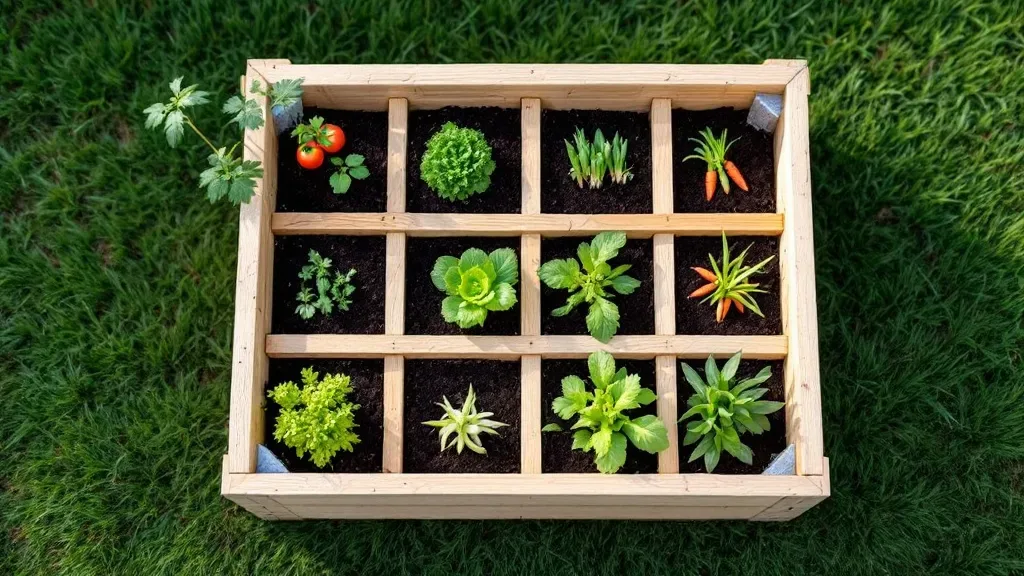
You have a 4x4 bed and a grid, and now you need to know what goes in each square. A square foot gardening planner is a sketch of that grid with one crop and one plant count written in every square, and this page gives you the counts and a full plan to copy.
Published
Step 1: Size the bed and mark 16 squares
A 4x4 bed holds 16 squares of one square foot each. A University of Wisconsin-Extension class handout says to build the frame no wider than 4 feet, or 2 feet if you can reach only one side. It suggests a depth of 6 to 8 inches and 2 or 3 feet between beds for walkways.
A 2016 Washington State University Extension article by a Master Gardener goes one step further. It says 3 feet wide is actually better, because you must reach the middle without stepping in. It also asks for at least 6 hours of full sun.
Lay the grid on top of the frame and leave it there. A Wisconsin handout says to keep the grid in place all season. The Washington State piece wants grid lines that are "prominent and permanent", made from twine or thin boards.
A small bed you plan on paper is easier to plant than a big bed you plan in your head.
| Step | What you do | Number to keep |
|---|---|---|
| 1 | Build a bed no wider than 4 feet and mark 1-foot squares | 16 squares in a 4x4 |
| 2 | Give each crop 1, 4, 9 or 16 plants per square | 12 divided by spacing, squared |
| 3 | Write one crop and one count in every square | 112 plants in the plan below |
| 4 | Replant a square when its crop ends | Compost 3 to 6 times a year |
Step 2: Match each crop to its plants per square
Plants per square depends on how big the crop gets. Washington State sorts crops by spacing. A 12-inch spacing gives 1 plant per square, 6 inches gives 4, 4 inches gives 9, and 3 inches gives 16.
You can check any count yourself. Divide 12 by the spacing on your seed packet, then multiply the answer by itself. A 4-inch spacing gives 3 times 3, which is 9 plants.
| Plants per square | Spacing | Crops named by the sources |
|---|---|---|
| 1 | 12 inches | Tomato, pepper, broccoli, cabbage |
| 4 | 6 inches | Lettuce, chard, basil |
| 9 | 4 inches | Bush beans, beets |
| 16 | 3 inches | Carrots, radishes, small onions |
Where the counts disagree
Published counts are not identical. A UF/IFAS Gardening Solutions page puts kale, potatoes and spinach in different groups from the Washington State article. The Wisconsin class notes side with one or the other, depending on the crop.
| Crop | Washington State | UF/IFAS | Wisconsin handout |
|---|---|---|---|
| Kale | 4 | 1 | 1 |
| Potatoes | 4 | 1 | 1 |
| Spinach | 9 | 4 | 9 |
Settle a disagreement with the spacing on your packet and the division in Step 2. If a packet says 6 inches, you get 4 plants. The plan below skips these three crops, so none of its counts is in dispute.
Step 3: Fill the 4x4 grid with a worked plan of 112 plants
Here is one full grid, drawn with the north edge at the top. The tomato and peppers sit on the north edge so their leaves shade as little of the bed as possible.
The row sums show where the 112 plants come from.
| Row | Squares | Plants |
|---|---|---|
| 1 (north) | Tomato 1, pepper 1, pepper 1, basil 4 | 7 |
| 2 | Broccoli 1, cabbage 1, chard 4, onion 16 | 22 |
| 3 | Lettuce 4, lettuce 4, beets 9, radish 16 | 33 |
| 4 (south) | Carrot 16, carrot 16, bush beans 9, bush beans 9 | 50 |
| Total | 12 crops in 16 squares | 112 |
The 4x4 bed plan in The Winter Plan is drawn at true scale, 1 inch to the foot. The same kit's master chart lists plants per square foot for 41 crops, so you can fill a grid for crops this page does not cover.
How many squares a household needs
The sample bed is a sampler, not a food supply. A Kansas State guide revised in 2023 lists an approximate planting per person of 3 to 5 plants each for tomatoes, peppers and broccoli, and 3 to 4 for cabbage. At 1 plant per square, one person's tomatoes alone need 3 to 5 squares.
The same guide says a 100-square-foot garden can produce a good portion of the vegetables for a family of four. A 4x4 bed is 16 square feet, so 100 square feet is about six beds. Count your household's favorites first, give those crops squares first, and fill the rest with fast crops.
Tall crops and short crops in one grid
A vertical frame, the Washington State article says, can stand at one end of the bed with netting for cucumbers, pole beans, peas and other vining crops. Pole crops take the squares along that frame, and you keep lettuce, radishes and carrots at the open end. The sample plan above gets its height from tomatoes in the top row, so its short crops sit in the rows below.
Four layout mistakes and the mid-season fix
A bed wider than 4 feet is the first. You cannot reach the middle, so narrow it with a path or a second bed next year.
Pulling out the grid is the second. Wisconsin says to leave it in place all season, and Washington State wants lines that stay put.
Replanting without compost is the third. Add a trowel full to the empty square, as both sources say, before the next crop goes in.
Thinning by pulling is the fourth. The Washington State article says to snip off the tops of the seedlings you do not want rather than disturb the soil, and to leave them on the soil to compost.
Step 4: Replant each square when its crop ends
The plan mixes cool-weather crops such as lettuce, radish and broccoli with warm-weather crops such as tomato and bush beans. Some squares will empty before others. That is normal in this method.
Harvest continually, the Wisconsin handout says, and when a crop in one square is gone, add some new compost and plant a new, different crop there. Washington State says the same, with a trowel full of compost. Wisconsin adds that you will be adding compost 3 to 6 times a year, because the organic mix keeps breaking down.
Rotate too. The Wisconsin handout says never to grow the same botanical family in the same soil year after year, and it names cole crops such as cabbage and broccoli and nightshades such as tomatoes and potatoes. In the plan above, that means two cabbage-family squares and three tomato-family squares to move next year. Redraw the grid on a fresh sketch and give each of those five squares a different crop.
Where a square foot gardening planner stops working
If you have one 4x4 bed and a pencil, you do not need a kit. The grid, the table and the plan above are enough, and a free sketch on graph paper does the same job. Free extension charts and printables cover the counts too.
The method also stops where your bed gets too wide to reach. Past 4 feet you need more beds with walkways between them, not a bigger grid. If your county extension office publishes a sheet with local crop counts, use that.
Free extension charts and graph paper cover the counts, and the kit adds the sums and dates done on paper. The Winter Plan draws the 4x4 plan at 1 inch to the foot and counts dates from the last-frost date you write in, with a 108-station NOAA freeze table for any US zone. After you pay, you get the download link by email, and the zip holds US Letter and A4 PDFs to print at 100 percent (actual size) so the grid keeps its scale. You pencil a crop and count in each square before sowing, look up the next sowing on the succession waves page when a crop ends, and move each crop family on the rotation planner at season's end.
FAQ
How do I plan my square foot garden?
Build a bed no wider than 4 feet, mark it into 1-foot squares, and give each crop 1, 4, 9 or 16 plants per square based on its spacing. Write one crop and one count in each square, then replant a square when its crop ends.
How do I plan my planting layout for a square foot garden?
Sketch the grid on paper, with 16 squares for a 4x4 bed. Give tomato, pepper, broccoli and cabbage 1 plant per square, lettuce and chard 4 per square, beans and beets 9, and carrots and radishes 16. Add up the counts to check the plan.
How to layout a square garden?
Keep each side to 4 feet so you can reach the middle, leave 2 to 3 feet between beds, and divide each bed into 1-foot squares. Pick a spot with at least 6 hours of full sun.
What are the disadvantages of square foot gardening?
Beds cannot be wider than 4 feet, so a larger garden needs several beds with walkways between them. The rich mix breaks down, and a University of Wisconsin Extension class handout says to add compost 3 to 6 times a year. Published plant counts also differ for crops such as kale, spinach and potatoes.
Conclusion
Plan the grid on paper before you open a seed packet. Build the bed no wider than 4 feet, give each crop 1, 4, 9 or 16 plants per square, and write the count in the square. Settle any disagreement between sources with the spacing on your packet. When a crop ends, add compost and replant that square, and next year move the cabbage and tomato families to squares that held something else.
Sources
- University of Wisconsin-Extension, Square Foot Gardening: A simplified method of gardening, class notes distributed by Michelle Grimm (undated), last checked October 5, 2026
- Washington State University Extension, Square Foot Gardening - Simple, Versatile and Fun! by Harriet Custer (2016), last checked October 5, 2026
- UF/IFAS Gardening Solutions, Square Foot Gardening (undated), last checked October 5, 2026
- Kansas State University Research and Extension, Vegetable Garden Planting Guide, MF315 (2023), last checked October 5, 2026