Sunchokes Planting Guide: Timing and Spread
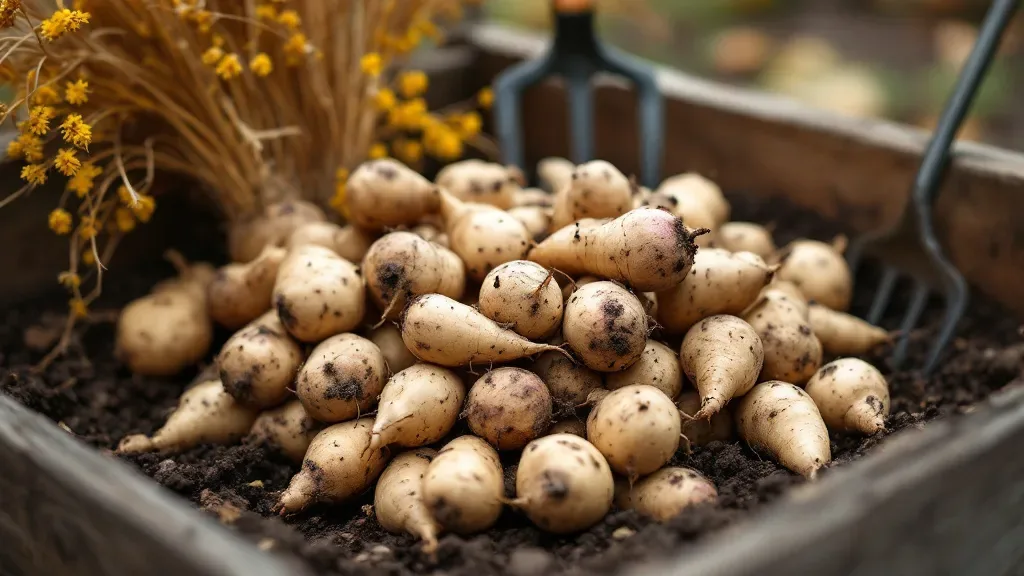
Sunchokes are easy to plant and hard to get rid of. A sunchokes planting guide comes down to one early spring date, tubers set 2 to 3 feet apart, and a bed you plan to dig clean every fall.
Published
A sunchokes planting guide in five steps
Sunchokes, also called Jerusalem artichokes, are a sunflower relative grown for the tubers. They are a different plant from the globe artichoke. The Arkansas sheet calls the sunchoke a perennial that is grown as an annual and may persist in the garden as a weed.
| Step | What to do | What to watch for |
|---|---|---|
| 1 | Plant in early spring | Soil at 43 to 45 degrees F in zones 6 and 7 |
| 2 | Plant whole tubers or pieces with buds | Do not let cut pieces dry out |
| 3 | Set depth and spacing | 2 x 3 feet per plant, plants reach 6 feet |
| 4 | Pick the bed for the spread | Any tuber left behind sprouts |
| 5 | Dig, store and eat | Dig from September until new growth starts |
Step 1: Plant in early spring
Plant entire tubers in early spring, says Arkansas, and NC State agrees. An Ohio State University Extension fact sheet from 2025 gives a date for zones 6 and 7. It says tubers can go in from late April until mid-May when soil temperatures reach 6 to 7 degrees C.
Soil at 6 to 7 degrees C is about 43 to 45 degrees F, so the soil matters more than the calendar. Arkansas also asks for a sunny spot, deep loam and well-drained soil.
The same Arkansas sheet lists 120 days to maturity. Count it forward from your planting day. Tubers planted on May 1 reach maturity on August 29, because May adds 30 days, June 30, July 31 and August 29 more.
Step 2: Plant whole tubers or pieces with buds
NC State says to plant whole tubers or pieces of tuber with at least two to three strong buds, the way you would plant potatoes. It adds that cut pieces should not dry out before planting.
Plant them as soon as you have them. Dry tubers lose their chance to sprout.
Step 3: Set depth and spacing
The sources give two depths. Arkansas gives 2 to 3 inches deep, 24 to 30 inches apart, with 3 to 4 feet between rows. Ohio State says about 6 inches deep and 2 to 3 feet apart. The two sheets agree on the spacing but not the depth, so check your own state's extension sheet.
| Source | Depth | Spacing in the row |
|---|---|---|
| University of Arkansas | 2 to 3 inches | 24 to 30 inches, rows 3 to 4 feet apart |
| Ohio State University | About 6 inches | 2 to 3 feet |
Arkansas lists the spacing as 2 x 3 feet, which is 6 square feet for each plant. A 4 x 8 foot bed is 32 square feet, so it holds five plants and a little room to spare. The stalks grow 6 feet high or higher, so choose a spot where tall plants will not shade smaller crops. NC State lists the plant at 6 to 10 feet tall and 5 feet wide, says it may require some staking or protection from strong wind, and asks for full to part sun.
Step 4: Pick a bed that can hold the spread
Yes, Jerusalem artichokes spread. NC State says the plant spreads by rhizome and self-seeds to form colonies, and that once established it may be difficult to remove. Arkansas says tubers left in the ground will grow, become troublesome weeds and spread in the garden.
A short University of New Hampshire note puts it plainly. Any small tubers left in the ground will sprout the following spring. Ohio State tells you to search the soil completely at harvest to avoid volunteers.
Plant a spreader where you would be happy to see it again next year.
Give the sunchokes a bed at the edge of the plot, away from the beds you rotate each year. Mark the corners so you always dig the same footprint.
Step 5: Dig, store and eat the tubers
Harvest time is long. Arkansas says to dig tubers any time from September until spring, before new growth starts. UNH says they are typically harvested in late fall, and that leaving them in the soil as late as possible before digging increases their sweetness.
Yes, you can eat sunchokes raw. Fresh tubers, says NC State, may be boiled, mashed, roasted like potatoes, or eaten raw. UNH describes a crispness like water chestnuts and a sweet, nutty flavor. It adds that 75 to 80 percent of their carbohydrate is a sugar called inulin, which the body handles more slowly than other sugars.
For storage, Arkansas gives 32 degrees F with 95 percent humidity, or a plastic bag in the refrigerator, because the tubers lose moisture fast.
Where a printed plan helps, and where it does not
A free state sheet is enough if all you want is the planting date. The four extension pages above cost nothing, and a planner adds nothing to a single patch of sunchokes.
A printed plot map helps when the patch has to fit among other beds. The Winter Plan's printed plot map and bed plans let you draw the sunchoke patch as its own box before you dig, and its rotation planner (4 years by 10 beds) keeps that box off the rotating beds. The kit counts from the last-frost date you write in, with a table of freeze dates for 108 NOAA stations, so your early spring planting day comes from your own zone and not from the Ohio dates above.
After you pay, you get the download link by email. The zip holds US Letter and A4 PDFs to print at 100 percent (actual size) on a home printer, so the plot graph keeps its scale. You draw the box in spring, mark its corners, and in fall you use the same page to check that your dig covered the whole footprint. The depths on this page come from the extension sheets above, not from the kit. A pencil and graph paper work too.
FAQ
When's the best time to plant sunchokes?
Early spring. The University of Arkansas and NC State both say to plant tubers in early spring. Ohio State gives late April to mid-May for USDA zones 6 and 7, when the soil reaches 6 to 7 degrees C (about 43 to 45 degrees F).
Can you eat sunchokes raw?
Yes. NC State says fresh tubers may be eaten raw, and the University of New Hampshire suggests cutting them into matchsticks for salads or slaw.
Do Jerusalem artichokes spread?
Yes. They spread by rhizomes and self-seeding, and any tuber left in the soil sprouts the next spring. Give them a bed of their own and dig every tuber out in the fall.
Conclusion
Plant whole tubers in early spring, give each one about 6 square feet, and dig the bed clean when the stalks die back. Decide the bed before you buy tubers, because every tuber you miss in the dig sprouts again. Put the patch at the edge of the plot and write its corners on your map.
Sources
- University of Arkansas Division of Agriculture, Jerusalem Artichoke, FSA6088 (undated), last checked October 5, 2026
- NC State Extension, Helianthus tuberosus (Sunchoke) Plant Toolbox (undated), last checked October 5, 2026
- University of New Hampshire Cooperative Extension, Jerusalem Artichokes, Info Line Question of the Week (undated), last checked October 5, 2026
- Ohio State University Extension, Growth, Harvest, and Serving Jerusalem Artichoke (Sunchoke), ANR-0167 (2025), last checked October 5, 2026