When to Plant Seeds for Spring: 16-Week Start Order
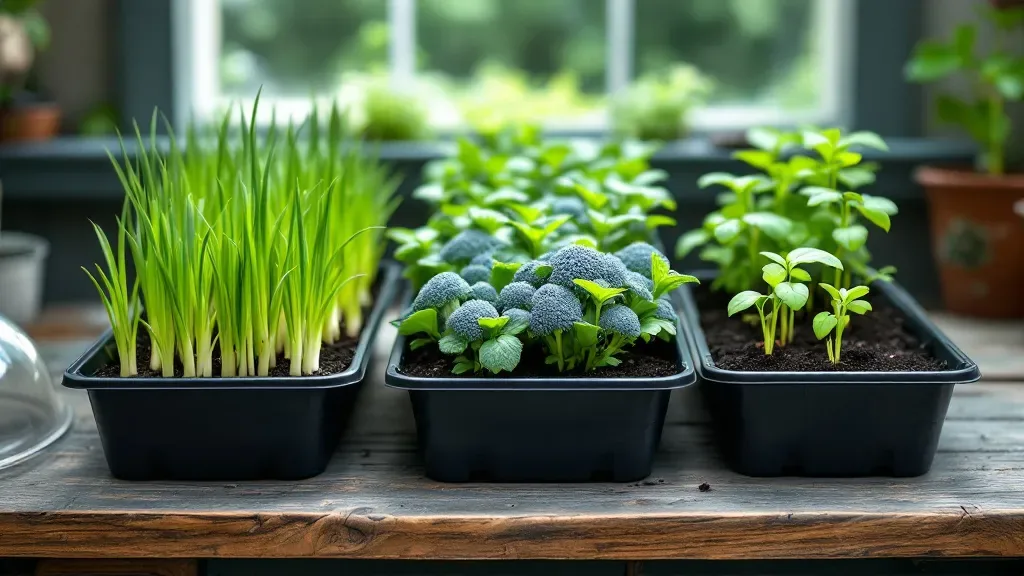
You have a pile of seed packets and no idea which one goes first. When to plant seeds for spring comes down to one order, with onions in a tray first, then peppers and tomatoes, then hardy crops outdoors, and warm crops after your last frost.
Published
Step 1: Pick the date every sowing counts from
Every spring sowing counts from one date, your average last spring frost. Your state extension service publishes it by county or by weather station. Write it at the top of a page and call it week 0.
Weeks before it get a minus sign. Weeks after it get a plus. Onions go in a tray at week -14, and a melon seed goes in the ground at week +2. The gap from first sowing to last is 16 weeks, or 112 days, and it is why one planting weekend never covers the whole garden.
The sample dates below use a last frost of May 10. Swap in your own date and the weeks still hold.
| Step | What you do | Weeks from last frost |
|---|---|---|
| 1 | Pick your last frost date | Week 0 |
| 2 | Start onions and cabbage family indoors | -14 to -6 |
| 3 | Start peppers, tomatoes and squash indoors | -8 to -3 |
| 4 | Sow hardy and semi-hardy crops outdoors | -4 to 0 |
| 5 | Harden off, set out and sow warm crops | -2 to +2 |
Spring planting is a sequence of dates, not a single weekend.
Step 2: Start onions and the cabbage family first
The slowest crops go in trays first. A University of Maryland Extension fact sheet on starting vegetable seeds indoors says onion, pepper and eggplant need 8 to 10 weeks indoors. It gives cabbage, broccoli and cauliflower 4 to 6 weeks.
Colorado State University Extension sorts onions, broccoli and cabbage into its hardy group in a vegetable planting guide. Hardy crops can go out as early as 2 to 4 weeks before the average last spring frost.
Now add the two. Onions set out at week -4 and grown 10 weeks indoors start at week -14. Set out at week -2 and grown 8 weeks, they start at week -10. With a May 10 last frost, that is February 1 to March 1.
Broccoli and cabbage work the same way. Grown 4 to 6 weeks and set out 2 to 4 weeks before the frost, they start 6 to 10 weeks before it, which gives March 1 to March 29.
Do not rush the early ones. Maryland warns that sowing too early gives tall, root-bound plants that do not perform well in the garden.
Step 3: Start peppers, then tomatoes, then squash
Warm crops start later because they cannot go out early. The Colorado State guide puts peppers, eggplant and tomatoes in its very tender group, typically planted 2 or more weeks after the average last spring frost.
Peppers need 8 to 10 weeks indoors, so the sum is 2 weeks after frost minus 10 weeks, which is week -8. At 8 weeks of growth they start at week -6. With a May 10 frost, that is March 15 to March 29.
Tomatoes need 5 to 6 weeks, so they start at week -4 to week -3, or April 12 to April 19. Maryland says tomatoes sown 5 to 6 weeks before planting out give stocky plants 8 to 10 inches tall.
Cucumbers and summer squash need 3 to 5 weeks. The Colorado State guide says transplants of both should wait until frost danger is over, which makes the set-out date week 0. Start them at week -5 to week -3, which is April 5 to April 19.
Step 4: Sow the hardy crops outdoors
Some seeds skip the tray. Colorado State's guide lists peas, spinach, lettuce and radish as hardy, and says they can be sown as early as 2 to 4 weeks before the average last spring frost. The same guide puts beets and carrots in a semi-hardy group, planted 0 to 2 weeks before it.
For a May 10 frost, hardy seed goes in from April 12 to April 26. Beets and carrots go in from April 26 to May 10. Colorado State's table adds one more test: sow when the soil has reached the minimum temperature for the crop, measured at 8 a.m. and 4 inches deep. The same table gives these minimums.
| Crop | Minimum soil temperature |
|---|---|
| Lettuce | 35 F |
| Peas, spinach, radishes, carrots | 40 F |
| Corn | 50 F |
| Snap beans | 55 F |
| Summer squash | 60 F |
Push a thermometer 4 inches into the bed at 8 a.m. for a few mornings. When the reading holds at the minimum, sow.
Step 5: Harden off, set out and sow the warm crops
Seedlings that never saw the outdoors get hurt by it. A University of Maryland Extension page on hardening vegetable seedlings says to begin 1 to 2 weeks before you set plants out. Put them in a shaded, protected spot on warm days and bring them in at night. Give them more sun each day.
The Maryland page also says to keep tender seedlings indoors on windy days and when it is below 45 F. Even cold-hardy plants get hurt by freezing temperatures before they are hardened.
Warm seed follows the frost date. In Colorado State's guide, tender crops such as beans, corn, cucumbers and summer squash can be sown from seed around the average last spring frost. Very tender crops such as lima beans, cantaloupe, pumpkin, winter squash and watermelon wait 2 or more weeks after it. For May 10, that is May 10 for beans and corn and May 24 or later for the melons.
If a late frost hits your seedlings
A hard frost after planting out is the risk of every early sowing. The Maryland hardening page says even cold-hardy plants get hurt by freezing temperatures before they are hardened, so do the 1 to 2 weeks of hardening first.
Cover the plants when a frost is forecast. A University of Maryland Extension page on row covers says lightweight cover gives 2 F of frost protection, medium weight gives 4 to 6 F, and heavyweight gives up to 8 F. It says to secure the cover to the ground with sod pins, boards, bricks, sandbags, rocks or soil.
A Colorado State Extension page on frost protection says blankets and sheets must be removed in the daytime so the soil can recharge its heat. During the day, open any cover at least a slit to prevent overheating. The page does not give a recovery routine for plants that are already frosted, so none is claimed here.
When to plant seeds for spring, all in one table
The sums above fit on one page. Each row below shows the weeks from your last frost and the dates for a May 10 frost.
| Crop group | Where | Weeks from last frost | Dates for May 10 |
|---|---|---|---|
| Onions | Tray | -14 to -10 | Feb 1 to Mar 1 |
| Broccoli, cabbage | Tray | -10 to -6 | Mar 1 to Mar 29 |
| Peppers, eggplant | Tray | -8 to -6 | Mar 15 to Mar 29 |
| Cucumber, summer squash | Tray | -5 to -3 | Apr 5 to Apr 19 |
| Tomatoes | Tray | -4 to -3 | Apr 12 to Apr 19 |
| Peas, spinach, lettuce, radish | Ground | -4 to -2 | Apr 12 to Apr 26 |
| Beets, carrots | Ground | -2 to 0 | Apr 26 to May 10 |
| Beans, corn | Ground | 0 | May 10 |
| Melons, winter squash | Ground | +2 or later | May 24 or later |
Your seed packet may give a different number of weeks, and the packet knows your variety. Use its number in place of the one in the table.
Tray time also matters for the dates you pick. Maryland says the mix should stay at 65 to 75 F until seeds sprout and the lights should hang 2 to 6 inches above the plants for 14 to 16 hours a day. If you start seeds in a shared flat, move them into their own pots soon after the first true leaves appear. Leaving seedlings in the flat too long is, in Maryland's words, one of the most common mistakes.
When your county calendar already gives spring dates
If your county extension office publishes a planting calendar, use it. A calendar written for your soil and weather beats a general count. Skip the plan too if you buy every plant at a nursery, because then only the set-out dates matter and the table above is enough.
A printed plan pays off when you grow from seed and juggle many crops. The Seed-Starting Countdown costs $7 and counts from the last-frost date you give it, so the weeks you just read become dates on paper. After payment the download link is emailed to you. The zip holds US Letter and A4 PDFs, printed at 100 percent (actual size) on a home printer so the tray maps keep scale. Free extension charts give dates for one county, and the kit adds the writing space: a log page per week, filled in on the day you sow, then the 14-day hardening-off table and the transplant day log.
FAQ
When should I start my seeds for spring?
Count back from your average last spring frost. Onions go in a tray first, about 10 to 14 weeks before it. Peppers follow at 6 to 8 weeks before, tomatoes at 3 to 4 weeks before, and hardy crops such as peas and spinach go straight into the ground 2 to 4 weeks before.
When to start seedlings indoors?
It depends on the crop. The University of Maryland gives 2 to 4 weeks for leafy greens, 3 to 5 for cucumber and squash, 4 to 6 for cabbage family crops, 5 to 6 for tomato, and 8 to 10 for pepper, eggplant and onion, all counted back from the day you set them out.
How do I start seeds indoors?
Moisten the potting mix first, fill clean containers with drainage to within 1 inch of the top, and sow small seeds one-eighth to one-quarter inch deep. Keep the mix at 65 to 75 F until sprouts show, then hold lights 2 to 6 inches above the plants for 14 to 16 hours a day.
Should I water soil before planting seeds?
Yes, when you start seeds in a tray. Moisten the potting mix before you fill the containers until it feels as moist as a wrung-out sponge, because dry peat-based mix repels water.
What are common seed starting mistakes?
The University of Maryland names three. Sowing too early gives tall, root-bound plants, overwatering can cause damping-off, and leaving seedlings in the seed flat too long crowds their roots.
How long should seedlings stay in trays?
Move seedlings started in a shared flat into their own containers soon after the first true leaves appear. The University of Maryland calls leaving them in the flat too long one of the most common mistakes. Total time indoors runs from 2 to 10 weeks, depending on the crop.
How long should seedlings be outside before planting?
Start hardening them 1 to 2 weeks before you set them out. Put them in a shaded, protected spot on warm days, bring them in at night, and give them more sun each day.
Conclusion
Spring planting is a sequence you can write on one page. Find your average last frost, put onions at week -14 and tomatoes at week -4, and sow the hardy crops outdoors from week -4. Hold beans and corn for the frost date and the melons for 2 weeks after it. When the frost date moves, move every date by the same number of weeks.
Sources
- University of Maryland Extension, Starting Vegetable Seeds Indoors (2026), last checked October 5, 2026
- Colorado State University Extension, Vegetable Planting Guide (2018, reviewed 2024), last checked October 5, 2026
- University of Maryland Extension, Hardening Off Vegetable Seedlings for the Home Garden (2023), last checked October 5, 2026
- University of Maryland Extension, Vegetable Garden Weather and Pest Protection (undated), last checked October 5, 2026
- Colorado State University Extension, Frost Protection and Extending the Growing Season (undated), last checked October 5, 2026